< back to writing menu
white pages are unpublished or just thoughts previously shared on instagram (etc) / yellow pages are published texts
2022
Composition
a contribution to the publication Tre
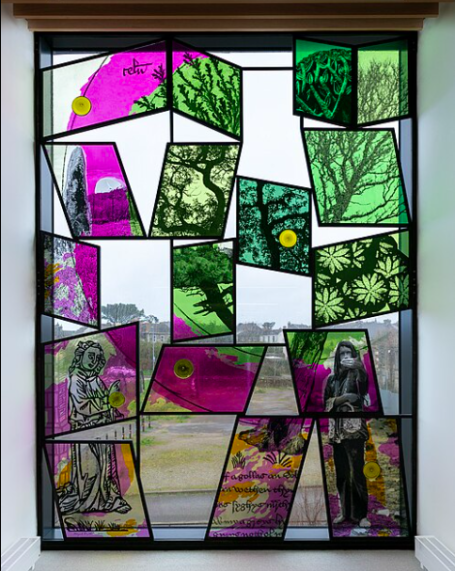
Abigail Reynolds, Tre: a window for Cornwall, 2022
at Kresen Kernow, Redruth
(photo: Nick Cooney)
The distinct rhomboidal windows of Tre coalesce toward a whole; a centralizing and oft re-told narrative of revisiting and regeneration. And yet each illuminated glass holds something idiosyncratic and ‘other’ to each of its immediate neighbours. The tree (which in the legend will seed the knowledge of good and evil, host the atoning sacrifice and so reconcile for original sin, and become splintered into multitudes of potent relics) is rooted amid the ancient script of the Ordinalia and grows to occupy the upper right and central parts of this untethered polyptych. As it does it flips from pine to oak, and shifts from drawn or carved decorative imitations into mimetic branch-like growths that arrive through the chance-oriented Mocha Diffusion ceramic glazing process (centre-top). The tree is singular, and it is polyglot; it is organic, mannered, and mysterious. Each window conjures the motif in a different voice and each window becomes a lens through which to comprehend the elusive story. These tinted lenses are reflexive. They colour and condition our perception of the world, all the while performing their illumination in response to the ever-changing light and weather of that same world. The story evolves as we read it because the earth incrementally ages as it spins through space.
The window is a chorus of different voices, and it embodies a simultaneity of multiple times too. Each pictorial element tells of the epoch from which it is transported through that moment’s stylistic tropes. Contrast, for example, the announcing angel, printed from a carved woodblock in the late c15th with Tre’s surrogate Seth, insouciantly photographed in the fashions we associate with the 1960s. Time is further encoded into these images as they are predominantly gathered from printed books (or their online equivalents) meaning that the technology for their reproduction becomes increasingly visible as they become vastly enlarged in scale, and these printing technologies are themselves rooted in time. The crudeness of the halftone dot found in mass produced books of the 1950s fizzes through certain sections of the tree collage and contrasts with the hazy digital tooth of the colour washes that bind and saturate its canopy. The printed images speak of their time, and they speak of moving through time, being produced and reproduced for the purposes of documentation, the sharing of knowledge or the telling of tales.
Communion is forged between Seth and the angel despite their apparent anachronism by our perception of their echoing, one of the other. The figures become twinned by the androgyny of their luxuriant hair and dress, their open, confident stance (their bodies rotated a mere half-turn) and their exchange of gestures – the one appointing or addressing with extended fore finger, the other framing, separating, and rendering momentarily mute with outstretched hand.
Floating at the wrist of the angel is a roundel of handmade kelp glass (its dense physicality and colour a manifestation of process rather than design) which disturbs the already complex and collagistic image with abstraction. Another green disc appears at the knee of Seth. A third hovers between the two protagonists in the pink band circling the canopy of the tree. The scattering of these alien material interruptions serves counterintuitively to unify the disparate parts of the meta-image. Like a constellation of stars, these discs (and the two in the top half of the image) act to bind the fragments so that a kind of energy between them becomes palpable Their coexistence and inter-connection suddenly feels inevitable.
This connection is one of text, stage and players, each distinct parts which come together to constitute meaning (as in the play by which the story of the Ordinalia would have originally been broadly disseminated), but the connection is never simply a re-telling of the same old story. Each image-fragment brings with it further time-encoded histories and associations, and these too are woven through one another to create strange new truths. Seth’s dark and upright form is echoed in the lone standing stone pictured in the distance beyond the tree. An association is made initially because the two forms look alike, but they are bound too, by how they connect with the ground on which they each stand. The mystical spirituality of the stone charges that place with a sense of ancient, anti-rational power, the very same power that lured the disaffected and countercultural baby-boomers out into the countryside to forge other communities and to pursue other consciousnesses. This collapsing of the space of Seth and the stone into a continuum of landscape transforms the silvery semi-circle (actually one of Goonhilly’s satellite dishes) into becoming the setting moon which brings to a close the festival wherein Seth stands surrounded by the detritus of the night before. Seth’s invitation then, in the text, to see once more into the garden, chimes with our current imperative to measure the impact of our own actions under the looming shadow of ecological catastrophe.