< back to writing menu
white pages are unpublished or just thoughts previously shared on instagram (etc) / yellow pages are published texts
04/2025
What we talk about when we talk about abstract painting
publication essay to accompany
A Gesture, An Action... Touching
curated by Stephen Buckeridge at APT, London, Apr 2025
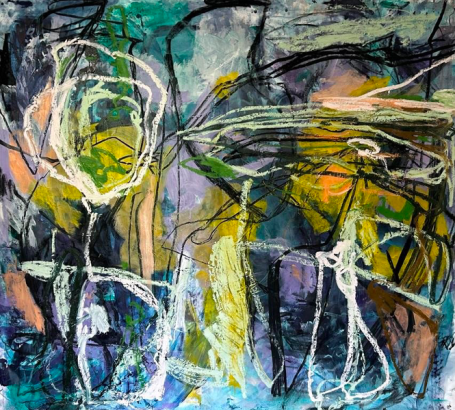
Stephen Buckeridge, Border Crossings... Traces of the Past, 2023
(photo: SB)
What we talk about when we talk about abstract painting
Abstract painting is hard to do. I know. I try it all the time, but the paintings very rarely leave the studio and even though they hang around, they never really seem… y’know… quite right. Abstract painting is hard to talk about too. We all seem to be so nervous of the assertive rhetoric that grew-up around and eventually suffocated mid-20th century abstract painting. Lately we have become less convinced too of those counter positions which flowered in its wake, such as process (for process’ sake), matter and agency (beloved of the pseudo alchemists) or irony (when is a drip a sign?). And yet… abstract painting remains vital, perhaps precisely because it is loosed from any need for it to become legitimised by an explanatory or aggrandising text (The Painted Word). But we do need to talk about paintings. We need, at least, to talk to ourselves as we are making paintings and it’s not enough to refer to ‘good bits’ or ‘thick/thin’, ‘in/on’, ‘fast/slow’, ‘control/chaos’ dynamics. So, inevitably some relics of those earlier ways of talking linger on and creolise our newer discourse. Suggestive, but nebulous ideas like ‘the expressive’, ‘the zone or the flow-state’ and ‘chance aesthetics’, as well as those given in the title of this show: ‘gesture’ and ‘action’. (The notable absence from this anachronistic lexicon is ‘form’, but we should save that for another text). We all use these terms, but we (or at least, I) don’t really know what they mean. Or more likely, I am increasingly unconfident that the things that they purport to mean aren’t really even able to be held in painting in the first place.
This exhibition proposes a momentary connection (a ‘touch’) between ‘gesture’ and ‘action’, so let’s think about those things and consider whether their inability to concretise interpretive ‘meaning’ is – counter-intuitively – more helpful for our understanding of the complex and uncertain qualities in the paintings gathered here, in this room.
‘Gesture’ is suggestive of an externalisation of an internal condition (an emotion, a feeling, a value). As such gesture is a kind of translation or outward manifestation toward an intent to communicate. A gesture is importantly the beginning of a communicative offering, it is the encoded movement (which may or may not leave a trace – in painting traces are all we do have – but in this text, we’re not quite at that stage yet). Helpfully, in the light of our new hybrid language of abstraction, a gesture might be automatic, an unguarded reaction, or, it might equally be performed or arch, ironic or phoney [cf. Pollock]. A gesture is the reaching-out from the inner self toward a readable trace. A gesture might leave a trace, but the trace isn’t a gesture. The trace is an index, a mark or scar, a consequence. A gesture is the journey toward that consequence. Our problem lies not in the in-between-ness of gesture. The problem begins even before that gesture is instigated, it resides in the delusion that the thing felt might be distinct or sufficiently clearly held as to be expressible at all. We all have emotive feelings, but even the sophistication of spoken language is unable to distil the nuanced interstitial we might feel in the undulating throes between grief and mourning, or as we float back-and-forth amid desire and pleasure. We feel all this stuff (and so much more), but not in any static or pure way whereby a gesture of the arm (with brush in hand) might forge an adequate account of such swirling – at times contradictory – emotive conditions. Gesture then is a kind of untethered impulse. The urge to gesticulate is truly felt, but the resultant gesture bears only a fleeting association with the thing(s) to be expressed. The trace, or mark, left after the gesture has passed has even less connective tissue with the thing which instigated it.
Recently someone sent my colleague and I the outline for a group exhibition. The proposal began with this quotation:
Marks in space are visibly connected in terms of meaning with the sphere of the mark,
but we need further investigation in order to say in what way.
Above all, they appear as monuments to the dead or gravestones.
Walter Benjamin
It feels to me like there is something of ‘marks in space/the sphere of the mark’ about gesture. Something is achieved, but each resultant trace or mark relates most generously to the host of other marks left by the previous and subsequent passings of the brush. One thing that we can be sure that they do say is that someone (or something) was present, and that thing touched this painting.
If – as I am speculating – the ‘gesture’ bears nothing but a tentative relation to its complex emotive source. We confront the opposite problem when it comes to ‘action’. All things are constantly in action. All things are ceaselessly acting with and against the flow of other things within which they exist. There is no such thing (in painting terms) as inaction. Painting is conventionally made by the application of pigmented wet stuff to a substrate whereupon the wet stuff gives-up its fluidity (quickly or slowly) and becomes dryer and firmer (note my insistence on -er, as, in a cosmic sense, even when the liquid paint is arrested to become an identifiable coloured mark, these, like all things are nonetheless incrementally changing to eventually become dust. The best paintings are always the most unstable as these have the truest sense of their temporality, their live-ness). Action is the smearing effect of a loaded brush being dragged linearly across a canvas, paint becoming wiped from its hairs and accreting in the tooth of the canvas weave. But action is also the capillary spread of those more saturated rivulets leaching from the edges of the brushstroke as they ingress the fabric fibres and casually bloom coloured stains from within. In the process of making paintings the painter performs actions. These actions are unavoidable tempered or deviated by the further action of contingent factors working upon the painter’s attempt. Such as hesitance, or doubt, or self-consciousness, or equally a momentary lack of control in the muscles in the arm, or an effect of the nervous system causing the brush to be gripped too tightly or pushed too firmly. These factors all have the consequence of an action being performed upon the painting action. Further to which we have the material stuff-ness of paint, chaotic and slippery, and always acting and acting again upon the other coloured patches around and beneath each blob, blot, stain, and smear.
The problem with the term ‘action’ as in ‘action painting’ is that it becomes tautological. Paint, the painter and the painting are all constantly in action. There is no part of this constituency which ever stops acting. If the ‘gesture’ doesn’t have a connection to its source, then the ‘action’ (as performed by the painter) doesn’t have a privileged connection to its destination. Once the painter-action is concluded, it is merely time for all the other categories of micro-actions to be sparked into life.
Painting then might best be described as the tentative shepherding of an unruly array of agencies toward the potential for ‘meaning’, whereby that ‘meaning’ is the commixture of speculative significance and atmospheric or contextual association. And, fundamental to that slippery ‘meaning’ is the material fact of its slipperiness. The act of painting and the object of painting both exist on the edges of communicable meaning (of manifest intent) from where they speak most eloquently of all, of the dynamic extra-linguistic truth of their inherent unsettledness. ‘Meaning’ is not coalesced, ‘meaning’ is burgeoning in its very inability to coalesce.
In Alaena Turner’s 2017 essay Notes on Touch, or Painting in the embarrassed condition she develops ideas that a painter’s touch (tache) might accrete and tally evidence of (albeit minor) brush-labour, and that the painting-touch might mediate a relationship between the painter’s body and the public. She weaves in the possibility that touch risks embarrassment and that embarrassment might be the appropriate response to the transgression of certain codes of behaviour (including the making of ‘bad’ paintings), and yet being embarrassed is a positive condition, as it demonstrably pledges not to act in this way again. But, doing this (touching; making ‘bad’ paintings) again and again is the essence of what painters do. Alaena proposes then that we ‘invert the formulation regarding touch, painting and embarrassment, so that painting makes a claim for blushing, as the physical manifestation of embarrassment, as one of its many possible operations.’
In reading the title of this exhibition, it slips momentarily between the twin propositions that (a): ‘gesture’, ‘action’ and ‘touching’ are among the possibilities for making a painting happen, and that (b): the urge to express (‘gesture’) and the movement of the brush (‘action’) are themselves becoming connected (‘touching’). Betwixt these ideas, a seed of a doubt is sown, and this is a doubt that we mustn’t be embarrassed about feeling. Just as Alaena Turner suggests that embarrassment is a positive condition, and that painting might itself become embarrassed upon being touched, so too might those knobbly, awkward bits of language that we continue to use, embarrass each other in their inability to foreclose on static ‘meaning’. And if language itself is embarrassed, they we speakers too might as well join in. As you walk around this exhibition of abstract paintings, why don’t you try talking about them (or even to them). If you’re reading this text having come away from the show, then message someone you reckon will be cool with being embarrassed with you. Go back to the gallery and both try to find words to talk to each other about these paintings and see how it feels. See how the paintings begin to reveal more of themselves as the words we use don’t quite fit or are not quite able to reflect the myriad touches, actions and gestures that hover and hum around and across their surface. And how in our striving for the mot juste it forces us to look harder, to linger longer, to tease apart and to try again. Fail again. Fail better.