< back to writing menu
white pages are unpublished or just thoughts previously shared on instagram (etc) / yellow pages are published texts
2022
Georges Braque: Still Life
in Turps Magazine issue 26
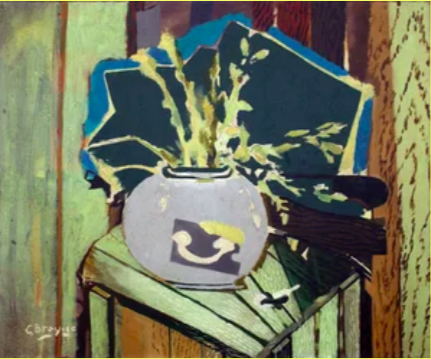
Georges Braque, La caisse verte (1952)
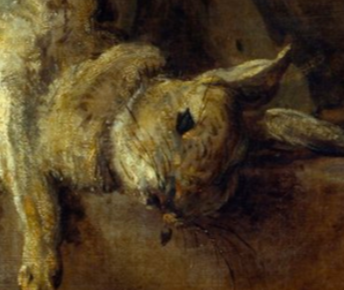
(detail of) Jean-Baptiste Simeon Chardin, Wild Rabbit with Game Bag and Powder Flask (c. 1729)
For a painter trained in decorative effects; in stencilling and wood-graining etc, Georges Braque makes some pretty rough and ugly paintings. How do we look at them then? How do we forget about the lionised achievements of his angularly articulated surfaces of pale-grey-ochre which characterize his ‘analytical’ Cubist paintings (c.1910/11) and at the same time, shake-off the pejorative determinisation that post-WWI Braque ‘retreated’ to the minor concerns of painting fruit baskets and billiard tables?
Start with what’s in the hole
There is a moment in Chardin’s Wild Rabbit with Game Bag and Powder Flask (c.1729) that could help here. There is a single, reflexive dot which gives a jolting realisation that still life painting is tragically and horrifically capable of coalescing the antithetical acts of bearing witness (looking) and conjuring likeness (making, or building). Still life is fundamentally about looking at things, but still life understands that when we look, we also see things that are not visibly there. Chardin’s moment is the raw black void of the dead rabbit’s eye socket. Not only does the animal’s eye-lessness re-calibrate the entire picture, creating a mocking self-awareness of our own eager willingness to see the dense mesh of sticky paintbrush strokes haptically, as if it were an expanse of fuzzy belly fur, soft beneath our outstretched fingertips. So too does this dark aperture reveal the very substrate onto which the picture is painted, and by implication the deep nothingness from which all things are brought into a temporary being. Through the hole in the rabbit’s skull, we encounter Frenhofer’s ‘dead wall of paint’ (cf Balzac’s Unknown Masterpiece) and Fontana’s concepto especial. The cosmic genesis and its apocalyptic inevitability. And that’s a lot going on in a modestly sized picture of, what will likely be the painter’s supper.
Is it possible then that the grubbiness and awkwardness of Braque’s still life paintings of the early-1920s to the mid-1950s (as recently gathered at Bernard Jacobson Gallery, London) is the aggravating grit with which we realise that we are not looking at a teapot or some lemons, or even a painting of those objects, but that we are actively striving to witness an attempt to understand those objects in our midst. An understanding that is premised both on careful looking and on slow making. Outside of the studio we continually think and process our surroundings at break-neck speed, we have evolved not to need to question the fundamentals of being (which we happily re-categorize as banalities). We indulge Science’s dogged close-observation (and speculative, or hypothetical, observation) as a kind of magical madness which allows for strange truths to be revealed to us concerning our frailty or our immutability, depending on the season. Painting, or more specifically, looking at painting, offers that same possibility whereby we see what is not there more urgently and more certainly than we see the objects which constitute the motif. Braque (and analogously, the viewer) isn’t interested in understanding the idiosyncrasy of a particular lemon, nor in understanding a reductive, Platonic ‘lemon-ness’. Instead, what we want, and need to spend time looking at, is the strange way that a greening lemon appears to be precisely three inches to the right of a squat black teapot and simultaneously to belong to another picture, in another time altogether.
In Théière Noir de Deux Citrons (1948) the lemon closest to us is modelled in space, with light articulating its swelling form. Four inches further back is a second lemon, this time more provisionally modelled. Neither is more or less lemon than the other, and their relationship in perceptual space is easy to judge. A scratchy white line is drawn around each fruit and yet somehow fails to undermine their respective volumetric propositions. A sea of viscous pale grey is then (ie later) painted up to, but stops short of, these inscribed lines. The pale grey is the most insistent and brutal passage of this painting. Unapologetically and unmodulated, it covers-over everything that might have been here through the early stages of the painting, and despite the heavy-handedness of this application, it brings a delicate and illuminating light into the heart of the picture. This grey paint (both quiet illumination and dense stickiness) describes the rounded base of a teapot, though locally its energy here is more pacific. It is as if a storm has abated in the time it took to shift one’s gaze from the fruit to the pot. Projecting above the two lemons, and serving to demarcate the gap between them, is a thick spout. The angle of the spout seems at once to rock the body of the teapot back on itself and to cause the lemons to incrementally roll apart. And amid this unexpected domestic drama, the teapot itself begins to diminish and disappear into the heavy air emanating from the darkness of the room.
Time is not the same
Any number of things have happened on the panel that eventually became Nature Morte: Prunes (1925). The picture is underpainted with a tousled form in sand-mixed paint that might have once been the licking tongues of a fire. It is more likely however, to have been the dense green foliage of a house plant. This thick, ugly trace haunts the current pictorial incarnation of plums and leaves on a white cloth. The gritty shape puckering the skin of the later painting demarcates a previous attempt to stand before a thing and to attempt to paint that thing. Somewhere in the life of the studio, that plant-painting was abandoned, either it was determined to be unsatisfactory, or else it was the arrangement of objects on the tabletop rotted and were changed. These plums do not pronounce their freshness by the shiny lustre of their dark skin or in their dusty glaucous bloom, these fruit just about distinguish themselves from the dull black of the shadowy cleft in their enfolding cloth. It is clear to see that Braque has touched their light-catching curves in flicks of thick white and their full forms have then been coloured in a thin purple, but only once the white has dried (days? weeks?). Later still an oily black line has been wrapped around the edges of these shapes. It is this black lacing line that is the most physical part of the heart of this painting, and it is this glossy web that carries our eyes in and around the ostensible subject. After an initial blocking-in of the white cloth, its brightness is brushed-over last of all with a semi-transparent wetness that laps up and around the leaves at the bottom of the picture with an arbitrariness that bears no relation to fall of light. These runnels of white are like the viscous black web of curves, they reach out hungrily and connect the plums one to another, and they connect the space of the viewer (and the painter) to thing observed.
My feeling that Braque’s previous attempts to make paintings are as likely to be abandoned because of the rotting or wilting of the motif, as by the failing of the picture is because these paintings are clearly made over long stretches of time, time enough for thick passages of paint to dry sufficiently before working further. In Légumier, Citron, Oranges (1924) the rhythmic wave crests of the tablecloth have surrounded the arrangement of lemon and bananas long before the pair of oranges were introduced to the scene. This painting then began with the gathering of fruit and tableware for the purpose of spending time looking and recording in coloured touches. At some point, seemingly the painting told the painter that the motif was insufficient, that the painting needed and wanted more. Two oranges were then added to the table.
Quick painting, slowly
Still life painting has a long-entangled relationship with the ephemeral, though this sense of all things passing, has from its very inception (in the Western tradition at least), been held in a dynamic check by painting’s own modest pursuit of immortality. Braque’s introduction of a couple of oranges as his bananas began to blacken and become fetted is not the same as the Golden Age Dutch flower painters holding the blooms of different seasons in perfect, anachronistic display. Braque’s tweaked and shifting motif is no more than a reason to look again with brush in hand. There is a quickness to his paintbrush-touch which is at odds with the duration of the making of painting. Today there abounds a bit of a cult of one-session painting. Auerbach is the most eloquently vocal on this, noting the moment when he realised that endlessly accreting layers of consecutive attempts to snare a feeling for a place or a sitter, needed to be abandoned for the daily scraping-back, to begin the whole work again the next day (retaining even the best bits, he insisted, was a trap to be resisted). Alex Katz is the anxiety-free incarnation of the purity of the single painting session (to his cost, arguably), and of course, Lynette Yiadom-Boakye, whose self-imposed restriction that paintings should be finished in a day, in order for them not to appear laboured, results in a catalogue of images no more complex than foggy memories. Braque seems to capture the freshness and provisionality of looking in the urgency of his dribbling or sticky wet marks, which are never lyrical or mannered. The fact that these looking/painting sessions are not constrained by a single afternoon at the easel make them hum with something akin to Cezanne’s doubt. It is the tangible traces of doubt that make the viewer resist accepting the objects simply for what they appear to be (the sign for a lemon, or the sign for a domestic still life), and instead to follow the flow and speed of their brush-pulls; to re-enact the decisions to obliterate, or to leave the ghosts of the colours and textures beneath each new layer. The uncertain, instability of the pictures’ process is analogous to looking at an arrangement of things, not as if close looking might reveal great truths (the logic of the enlightenment, embedded in the earliest still life paintings), but because looking is a mobile, ranging process that delights in the strangest events that occur as object-forms provisionally coalesce as liquid paint dries or as one colour is tempered or bruised by its underpainting.
The edges of things
The mass of foliage in Corbeille de Fleurs (1925) ends abruptly as a casually drawn contour demarcates the pot of flowers from the dun-coloured, sand-flecked wall, against which it has been arranged. It is very clear that the wall colour is painted after the flowers, and not simply that the grey-brown of the wall has been painted up to this hard contour, but that the vessel of flowers has been masked by a stencil so that the wall colour can (toward the completion of the painting) be applied in a single, liquid action. The decision to wrap the room around the motif in this way establishes a collagistic relationship (where collage is the arch sign of ‘other’, and collage is therefore a live meeting and negotiation of differences). The foliage appears to be momentarily displaced from the room, as if seen through an aperture, or cut-out and stuck on top. It is the very antithesis of the atmospheric (impressionistic) dissolve that binds all things in light as a continuum of perception. And yet a kind of continuum is established by the insistent grittiness of the sand-infused underpainting. Amid this idiosyncratic materiality, another level of stencilled cleaving occurs, though with far less of a sense of disconnect. Each of the seven orange-green flowerheads seems to have been applied through a stencil directly to the black and sand-primed board, with the leaf matter later filled-in in two greens with a wristy dashing back-and-forth of the brush. The flowerheads achieve a confluence with the leaf matter because of their proximity, and because they constitute a greater thing (the pot plant), which is itself quasi-distinct from the room in which it sits. The happy confusion of spatial or pictorial belonging and not-belonging is completed as Braque introduces a dark red-brown within the left-hand contour edge of the plant form, this colour area reinstates the horizon line between tabletop and wall and, in that small area of the painting, seduces the viewer into reading the stencil contour as a sharp shadow edge, which of course it is… and it isn’t. This painting of a pot of flowers exercises a sense of troubled belonging whereby its energy and purpose (in organic growth and in painting-making) are not sufficient to allay fears that something is not right, something is discontinuous, or that something is not where it should be.
This thick air
The variously conjured birds that multiply through Braque’s paintings and prints from the late 1920s are at their very strangest in the late Studio paintings (1949-56). The dense concertina-layered spaces of transparent easels, edgeless canvases and junk shop-jumble of pots and palettes, busts, newspapers and foodstuffs, becomes the charged air which teases these giant birds into existence. Perhaps slipping from the surface of another painting, or perhaps materialising as a spirit-of-the-studio, these avian spectres dominate the space of looking and making despite their autonomy from the observable world. Contrary to shifting arrangements of fruit, pots and cloths through the evolution of the still life paintings, the birds have no source, they emerge from between the layers of air excavated in the slow process of painting.
In La Caisse Verte (1952) borders and edges likewise become the breeding ground for something like the auratic. An enveloping thin grey-green skin has, late in the process, been applied over the right and left extremities of the space so that the light of the foreground stretches out to the picture edges. Meanwhile in the centre of the composition a thick air is brushed-in toward the sticks and stalks of the plant form in a dark green, sand-infused paint, edged-around in a blue that isn’t local to the scene. The plant itself is described more by the holes in the density of this dark green space than by the cursory articulation of leaf and stem. In the logic of the motif, the stems emerge from a pale grey, round-bodied pot, placed upon a rough-looking wooden side table, before a panelled wall. The painting tells us this, but the painting becomes something far more electric too. None of the transitions – from pot to table, or from plant to air – are alike. Some have stuttering contours, some have hard edges, still others consist of a threshold entirely absent of paint matter. The painting builds itself through these differing edges. It rocks and shifts as it is looked at; as the eye navigates from one coloured, textured area of paint to the next. The joyously uncertain transit of the gaze is given form analogously here too in the decorative device of wood graining. Braque’s faux finish techniques hold back from coalescing into a convincing trompe-l'œil, instead they prise apart the pictorial and material constituents of what painting is. The scratchy and agitated brown-black graining marks running up the right edge of the painting speak clearly of the material nature of the motif, they simultaneously echo the multiple iterations the dynamic contour of the living, growing plant. The thin, wriggling white graining marks are far subtler. They crawl along the planks of the table, feeding the eye back into the heart of the picture. But just as the eye doesn’t navigate a painting in a singular way, these grain lines quickly veer off from their descriptive purpose, instead riding the eddies of oxygen as the thick air swirls through the crevices and thresholds of the painted space. There is no air as dense and potent as the air in a painting studio, loaded as it is with heavy looking and the multitude of possibilities that heavy looking presents the painter with. And nobody paints the density of studio air like Georges Braque.