< back to writing menu
white pages are unpublished or just thoughts previously shared on instagram (etc) / yellow pages are published texts
2024
Burn down the galleries
published in Painting (n,v), Kingsgate Project Space, London (2024)
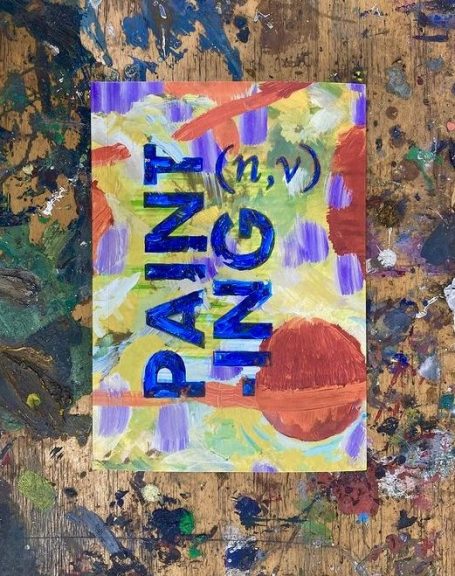
Painting (n,v) (photo: Joe Lyward)
I’m frustrated, and I’ve been so for years, by the fact that people rarely look at art – not the collectors, not the directors, not even the artists. The only people who care about the work are art students and online trolls.
Jesse Darling
There are plenty of artists who don’t have exhibitions. There’s plenty of art that’s never seen […] The novel that never gets published – should it never have been written? Of course it should be. It’s making a fantastic contribution to the culture of the moment because that individual has that huge urge to do it without any other qualifying pressures.
Phyllida Barlow
The twentieth century was a long slow enshrining of the exhibition as the apotheosis of all artistic possibilities. Early on, Duchamp’s mayonnaise – with four key ingredients: an object to be selected; an artist to appoint that object; a gallery to contextualise it; a viewer to encounter it – ramped-up the viewers’ role in the creation of the art event, becoming not mere perceiver of gestalt spectacle, but co-author in the work by bringing to the encounter their personal experience of (a) art traditions and conventions, and (b) shopping, as they each step into the gallery and consider the objects therein. Greenberg later gave a version of the same proposition whereby it was through the viewer’s eye that the spatial (and therefore self-critical) quality of painting was accessed. Conceptual Art quickly replaced the eye with a quizzical brain, but each was similarly striving to transform the viewer from mere receiver to becoming the critical agency in the business of the work. As the twentieth century ground on, the once empowered gallery visitor first became a somatic prerequisite for the work, and then a passive endorser of the culture-wars values proposed in the notes accompanying each exhibition. The only job of the viewer became to turn up. But, as art (in the publicly funded sector) by now was indelibly entwined with the leisure and tourism industries, as well as with regeneration and societal improvement agendas, getting people to turn up became essential. Visitor numbers became a matrix of success and so they were counted as a way for institutions to leverage further funds. Viewers no longer completed the work, now they perpetuated the infrastructures of art. Their agency is not in the business of the work, but in the business of the business.
The problem is not galleries and exhibitions per se, the problem is what they have become. Just as the church, the court, the salon, each in turn acknowledged the restrictive tendencies of its precursor, perhaps it is our collective responsibility as painters to stop thinking about well-lit, white-walled galleries (with e-mailing lists) as if they continued to operate at the height of their empowering powers 30, or 50, or 100 years ago. And if galleries don’t work – if the viewer is so bewildered by the problematics of slow, questioning looking, and has, by implication, lost the ability for the art event to be fostered in the encounter with an object – does this render paintings art-less? If the viewer (retinally or otherwise) completes the work, what happens to a work without a viewer? The Solomon R. Guggenheim Museum (New York) recently legitimised their ‘slowdown’ from twelve exhibitions per year in 2013 to a proposed two per year, not as a means to encourage return visits, deepen engagement with artworks, or provide a less crowded and compromised viewing experience. No, the reduction in activity is to lower costs, avoid staff burn-out and to align with the city’s peak tourist seasons. Most public institutions in the UK are moving the same way (a notable exception being Bexhill’s De La Warr Pavilion, which this year will stage eight exhibitions). Fewer exhibitions across the board, of course means fewer opportunities for artists to have their work exhibited before viewers, leaving more paintings (etc) un-looked-at in studios.
In Igniting Penguins: A Manifesto for Painting (2023), Rachel Lumsden describes what happens when she encounters ‘good’ art:
The stream of the unformed and wordless in me is given form and expression for a precious moment and connects me with the complexity, the ambivalences, the constant shape-shifting of the world. This moment reconciles my inner life with the outer and allows me to travel back and forth between them.
This sounds great. The liveness of (being with) painting isn’t just about the critical reflexivity of form (although it obviously involves that), nor is it exclusively a philosophic thought experiment (it is a bit of this too), or an endorsement of one’s own ethical, or stylistic values (it’s definitely not that). Being with painting is the ability to momentarily have a heightened sense of what it means to be in the world, and what it means for the world to be within us, and, as the world is itself unknowable and ever-changing, clarity is not the thing being sought through this encounter. What’s more, Lumsden goes on to identify why it is possible for you or I to have this strange engagement with ‘good’ art:
This multi-dimensional journey is only possible because the artist has done it before and paved the way for it with her work.
It transpires that the viewer stood before (or amid) the work within the gallery isn’t the only condition whereby an art event is able to occur. Lumsden points directly back to the studio where she states that the painter has already experienced a glimpse of that engaged encounter with the world. The painter’s snaring of this possibility (for others) could be understood to be a kind of prerequisite for paintings being ready to leave the studio. It is certainly (in Lumsden’s terms) the threshold by which they become ‘good’ art.
The painter, as well as being the maker, is obviously, also the first viewer too, although it is incredibly difficult to see with clarity the successes (or otherwise) of a day, a week, a month in the studio. It is a painter’s responsibility to learn to look – not in a quality control way, but in a quality-of-experience way. But painting (even ‘good’ painting) isn’t simply the potent object that emerges from the studio following a period of ‘production’, to be looked at by others. That is painting-noun – the thing of it. To confuse painting-noun with painting-verb – the doing of it – is to make a category error, but one which, because of the hegemony of (20th century) gallery-thinking is easy to fall into. Standing with a brush in one hand and a rag in the other, before a canvas onto which a line or a daub or a stain of colour has just coalesced, thinking about how to respond to it with the next touch (or wiping-off), is painting. It is live, existential, worrying, joyous, extra-linguistic painting. Sitting in the studio before a becoming canvas, unsure about how to make the next move without recourse to the ways that we usually bring paintings to their fruition, is precious time. Scaping a passage of painting back, having been delighted by that very paint-incident for weeks, is anxious and energising. Each of these thinking-making actions are the reconciliation of inner and outer lives, in Lumsden’s phrase. And none of these painting events take place without also being mindful of that Giotto fresco you saw in Padua, and that old friend you really should get in touch with, and the horrors of the conflict in Gaza, and the folly of space tourism, and the looming ecological crisis, and that novel you are reading, and how much you love your children. Painting (verb) is an immersive space, but it isn’t a hermetic one. On the contrary, painting is a protracted event made-up of thousands of micro-events, through and around which stories and ideas, questions, associations and arguments weave themselves. We do not paint a response to those thoughts, we paint among them. Thus, paintings (noun) do not portray, narrativize or mimic these concerns, but they are sensitive to them.
All this talk about time and space spent in the act of painting might sound a little like wellbeing or catharsis – a kind of painting-like act which is legitimised by its own internal sense that the process alone brings about a sense of peace, or a centred-ness. No, painting (verb) is too treacherous, too awkward, too surprising, too brilliant; it is subject to too many contingencies for that kind of fuzzy myopia to be sustainable.
Painting doesn’t need a gallery to legitimise or complete it. Painters do not require exhibitions. Yes, an art event is able to occur between the (active) viewer and the painting (noun), but that is only ever an echo or an extrapolation of the primary slow-event that happened through weeks and months of studio painting (verb). What then should we do with galleries? We could burn them down as they don’t work anymore, and it galls to watch as directors and curators populate exhibitions with objects that few visitors have the inclination or ability to look at (and with). To this incitement to raze I am going to assume the RS Thomas position (regarding second homes in Wales owned by the English), I am not leading the charge, but I certainly wouldn’t condemn those doing the burning.
Meanwhile as New York’s Guggenheim edges toward two exhibitions per year, deputy director and chief curator Naomi Beckwith is currently considering interspersing exhibitions with “research and special presentations that might not be open to the public”. There will be viewers, just not passive, touristic viewers. This is interesting. Instead of wholly retreating back to our studios, newly confident that these are a spaces where art events already occur, maybe we simply need to forget all our previously held assumptions about what galleries and exhibitions and viewers do – for and with painting – and recharge those conditions to bring about a new possibility for looking at art. Admittedly, there will be fewer visitors to exhibitions, but they might stay longer, and they might even come back a few times to regain that extraordinary, hungry, empowering sense which became tangible the first time they really, slowly, looked. We can each remember becoming lost in a novel, or caught-up in a play, or transported by a concert. All that is possible with painting too, only we have forgotten how. Moreover, we have for a long time stood by while our gallery visiting habits lazily evolved to preclude that very possibility.