< back to writing menu
white pages are unpublished or just thoughts previously shared on instagram (etc) / yellow pages are published texts
2024
Duel / Dual
gallery notes to accompany For Want of (not) Measuring (part III),
at Project78Gallery & Solaris, St Leonards-on-Sea
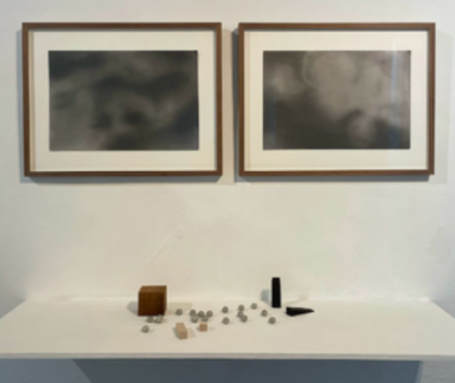
Andy Cluer,
Drift / Hum, 2020
Duel/Dual
In Ridley Scott’s 1977 debut The Duellists, pettiness (or honour) compels two fellow soldiers to confront one another, and so resolve their differences in the ultimate manner. Time and again, circumstances deny either fighter the final mortal strike. The laws of rank, the particularities of military postings, the ebb and flow of the Napoleonic project, weather, landscape and temperament in turn transform this conclusive confrontation into a spiralling sequence of episodic encounters where bitterness and hatred begin to foster a mutual dependency. Each unresolved duel weaves the protagonists closer to one another, towards a situation whereby they each need the other in order to understand and perpetuate their own internal sense of purpose. The tangled knot of self-knowledge within each combatant is achieved not through a definitive action, but through the different attempts made to valorise the idea or principal that inspired the first exchange, and so instigate the contingent outworking that we might call pursuit; or becoming.
For Want of (not) Measuring is a duel of sorts, though not quite with sabres and pistols. In Spring 2022, this show was inaugurated at Kingsgate Project Space as Patrick and Jim, who’s friendship and similarly questioning practices, were given space to test a way of coexisting. Grids and meters, measuring poles and maps were among the methods whereby electric lamps and landscapes; biographies and exploratory journeys, were analogously given comparative values (measurements) however unstable, unreliable, and uninterpretable this data gradually proved to be toward gaining greater understanding of the subject(s) in question. For Want of (not) Measuring seemed to embrace the drive to measure, even as the act of measuring played against itself. Lumens and hertz, kilograms and meters (each given alpha-numeric value, plot points on a graph, or needle points on a dial) became dizzying in their polyglot cacophony; hazy in their aesthetic liberation from indexical order. (Never has so much grey looked so good). As the title suggests, the artists capturing of data wasn’t ever gathered here purely for its own sake. Through his comparison of the relative brightness of automotive headlamps, Jim was attempting to remember his dying father. In wrestling his measuring stick up a (sublimely) misty Schiehallion, Patrick lovingly mocked the Romantic aspirations of landscape painters. Amid the densely arranged walls of drawings, photographs and films at Kingsgate hung a modest page simply reading DUEL/DUAL. The duel, it transpires, is not just between the artists (their respective ideas, intentions and egos), nor is it merely between the world as we find it and our attempts to contain it by measuring. But, in a more profound sense, the duel is forever within ourselves, as one ambition or desire is nuanced or complicated by a competing impulse to upset the primacy of that first intention.
This might be a good description of an entire life of making art. Each work proposes questions, to which, the next work hypothesises responses, and through which, further questions inevitably emerge. Those questions are ideological and formal, material and linguistic. It is certainly a good way of thinking about the sequence of exhibitions arising from the Kingsgate show, of which the Project 78 Gallery / Solaris show is the third of a sequence that might feasibly run and run.
In making this iteration of For Want of (not) Measuring I was keen to think about the unresolvable continuum of The Duellists, and the inherently irreducibility of two-ness; the duality of all things.
Johanna Love makes vast topographic lithographs based on electron microscopic images of dust particles. The coincidence of the advent of the first microscopes (and telescopes) and the advent of the artist studio in northern Europe is unsurprising, in both cases close looking sought to replace the divine-unknowable with the observable-fathomable. At the instigation of the Enlightenment project, art and the natural sciences were a singular occupation predicated on what might be witnessed by Man, and through which it might become possible to remove the need for god(s) to fill in the blanks. The dust painstakingly mapped in Jo’s recent collection of prints (first shown at Museum Kloster Bentlage, Germany) is taken from the 1499 Bentlager Relic Garden housing the bones of 46 named saints and other anonymous relics. These relics inspire pilgrimages, both devout and secular. They hold the possibility for miracles, and they also locate the question of why such anti-rational faith might perpetuate even now. In these asteroid-like images each idiosyncratic plane and crevasse is revealed to the eye (as if for the first time), and as we see more, and see even closer, nether the key to their mystery nor the conclusive debunking of their charmed power is revealed. In fact, it is hard not to wonder anew at the cosmic splendour of our unknowable world, where (the modern cult of) science serves only to excavate new gaps for new speculative projection.
In recent works, here shown, Lynda Laird twice employs the strange chemistry of photographic image-making to depict the sea as it ebbs and flows, changeably delineating the land’s end. In advance of printing, arrays of salt crystal are cultivated across the 5x4” negatives of a series of images of the maritime horizon at moonrise. The organic-chance distribution of the blooming salts echoes the galactic star-scape and suddenly the micro- and macroscopic are twined. There are other analogous couplings too. The skin of the negative film becomes like the surface of the channel, absorbing and reflecting light; the saline soup of the sea becomes like the developing fluids from which the film emerges, its image fixed until time eventually turns even these frames to dust. In Lynda’s cyanotype works of the water’s edge the camera-less photographic process is pushed as close as possible to the motif to be recorded. Such an intimacy deprives photography of its very purpose – to picture the world – leading instead to a collection of abstractions. These works collectively propose a kind of knowing without recourse to image – the intimate record of a wave lapping over prepared papers. And yet, simultaneously, they cannot help but to begin to conjure nascent, proto-images where the energy, drama and dynamism of a wave becomes a form, without need for the monocular lens of a camera.
The landscapes that Andy Cluer captures are recorded with a technology which similarly results in visual fields without need for image. Instead, his soft graphite drawings aspire more to the condition of a mist, or of cloud. Durationally made in direct response to the acoustic environment of specific places, it might seem counter-intuitive to render an inherently visual artefact. However, in doing so, we become increasingly aware of these spaces’ infinite complexities. While walking, our high-speed sense-data-processing brains quickly allow us to navigate familiar or unfamiliar terrain, but by consciously slowing down this evolved efficiency, those places cannot help but reveal layer beyond layer of experiential possibility. Andy’s drawings propose one such encounter, and whilst doing so they indicate the symbiotic relationship between landscape place and its inhabitants – including us. Just as these drawings rely on tools, from the field recorder to the drawing stylus, so too are these landscapes shaped and conditioned by a succession of human-centric events, from deforesting and path-making to the establishing of field boundaries and species management. The moorlands and forests that Andy depicts do not themselves propose Nature as an elemental, essential condition, but neither are these landscapes utterly known, domesticated, and compromised by man. Man, after all is that same cluster of atomic matter that constitutes the greater environment; man is of Nature. It should not surprise us then to find that foley sound is fundamental to the making of Drift | Hum. Foley and field recordings are both sound, and in the superficiality of their difference lies the root of their shared connection into the amorphous sound cloud of all vibrating matter.
The world as found, and as processed by recording devices (cameras), appears once again as the dominant motif within Caroline Jane Harris’ works. In these works, clouds and breaking waves together begin to propose an imagistic continuum, just as they cyclically become one another in the world around us through the processes of evaporation and rainfall. The images lurk on the threshold of legibility, and it is a legibility that we have learned to read from digital data rendered as bitmap images. The hard binary of bitmap is softened here by the material vulnerability of the paper into which the intricate grid is hand-cut, causing the surface (which doesn’t hold the image as much as manifests the image) to appear on the threshold of collapse. The image of the cloud, or of the water, is made by the removal of thousands of tiny squares of coloured paper, and in the gaps and voids left by this process, the world that exists before, around and beyond the photograph, ingresses. The oxygen of now, of the very moment of us looking at these image-veils, is what allows these blue and black papers to become an image of something transportive and transformative; of something utterly commonplace and yet undefinable. Within each sequence of works is a third drawing made by passing pigment ink across a new page placed above the cut paper, as if making a brass rubbing. An image is fleetingly captured in these repetitive horizontal bands, but like the cut works, entangled with their sense of precariousness is a strong feeling for something ancient, even timeless.
In Polytechnieou Waltz, Jim Hobbs documents the pavement beneath his feet on a short walk from one end of the street to the other, pausing mid-perambulation to dance a brief waltz, alone. Recorded anachronistically in Super 8mm, the film is rewound and reloaded into the camera at his destination, to then expose his return walk-dance-walk on top of the original footage. In November 1973 this street was the site of the Athens Polytechnic uprising, and this knowledge serves to make the location momentous, tragic and pathetic. History encodes place, but also becomes lost amid the gaps and accretions that craze and patinate a constantly evolving metropolis. Jim’s dance is instigated by the transition from a grid of rectilinear tiles to a section of angular, polygonal blocks midway along the street. His dance, which he performs alone and – through double exposure – with his second self, commemorates the uprising, but does so by speaking a different language. This short dance doesn’t hope to celebrate, or salve, or mourn, or account for, that moment, but somehow it records the possibility of that event to be considered among the multiple conflicts and complications that we each live with and through; those that we come close to making a peace with and those which remain deeply traumatic or unknowable.
The grids of tiles and blocks that form the street are captured on a roll of film which is itself a linear grid of cells. Grids quietly dominate much of this exhibition, within the works and in the ways that these works have been presented. Rosalind Krauss keenly saw the structure of the grid as focussing inward, to an hermetic space for (visual) contemplation, and unavoidable, also spiralling outward, acknowledging the work in question to be a ‘mere fragment, a tiny piece arbitrarily cropped from a larger fabric’. In Jim’s film the grid begins ‘in the world’, it is absorbed and abstracted to become a kind of structuralist mechanic, only for it then, to once again become a dancefloor for an improvisational choreography that is personal and social, demonstrative and meditative.
In Patrick Adam Jones’ ongoing series of twinned images, the closeness of their focussed content belies the depths of their fundamental differences. Taken with an adapted stereoscopic camera, subjects which include a field of daisies, or a Scottish mountainside, are annotated as if to number, name, or inscribe values to their constituent parts. The camera produces an image on the left which corresponds to the left eye and one on the right which is shifted in its perspective to provide a perceptual account of the world more readily in tune with the way that our brain conjures depth of field, and the space between objects. The annotations written onto, and occasionally erased from the images, are locked in their reference to specific visual occurrences – a flowerhead; a summit – but their casualness suggests they do not have descriptive value, but instead they have place-holder value. This specific daisy is marked ‘he’, while that particular daisy is ‘you’; that distant valley head is marked ‘I’, while this rocky escarpment is ‘they’. ‘He’ and ‘you’ are typographically different. As pronouns they propose differently signified individuals. Although they also open-up the possibility of confusion as ‘you’ and ‘he’ might be one and the same, and the ‘I’ reading this work might themselves choose ‘they’ as a given pronoun. All such markers are at once specific and deeply personal, and of course, utterly arbitrary. The left eye sees and processes the perceptual world one way, the right eye, in a slightly nuanced or dislocated way. Both are true and alike, but they are not the same. The world, it transpires, reveals itself to us, not in the way that it coalesces to become a singular thing (or collection of things), but rather in the ways that it refuses to be confined to, or cajoled into, anything that might be definitively knowable.
In Patrick’s DUEL/DUAL a zig-zagging brushmark wends its way up the page as if finding a suitable route up a mountainside and providing, either the gentlest incline, or the broadest array of aspects. At the bottom and the top of this brush-path is stencilled the word START. In completing the journey to the top, one might either give up and die, with the safe sense of achievement gained by this modest summitting, or one might begin again on the next journey down the mountain.
As we are all latterly learning, binary two-ness doesn’t describe any of the important things about us and our engagements with the world. We are not one thing or the other, and neither are those objects, energies and relationships within the world, of and toward which, we are both co-dependant with, and alienated from. The simultaneity of the future and the past; a repulsion that is also a desire; an ironic distance which cannot preclude an experiential authenticity (etc), open-up territories between poles which additionally hold facets of our multifarious selves. Just as in Rabelais or in Bruegel, the grotesque proposes metaphoric extremis, but so too does it reveal all of the points of possibility between our presumed position and our carnivalesque potentiality. Despite itself, measuring cannot help but snare all of the territory that hovers between the twin possibilities of empirical knowledge-gathering and the mystical playground. The act of subdividing all observable phenomena into countable units is itself the demonstration of a kind of faith, and as with all doctrines, the gaps between those integers quickly become haunted by all kinds of secondary narratives, unreconcilable abstractions, and wonderous spectres. The mystical and the rational, as competing belief systems feeding on each other’s perceived failings, will never accept one another, and as such, the duel continues yet.