< back to writing menu
white pages are unpublished or just thoughts previously shared on instagram (etc) / yellow pages are published texts
10/2025
Ed Saye: Once Emerged from the Grey of Night at Chapel Arts Studios (CAS), Andover
gallery notes
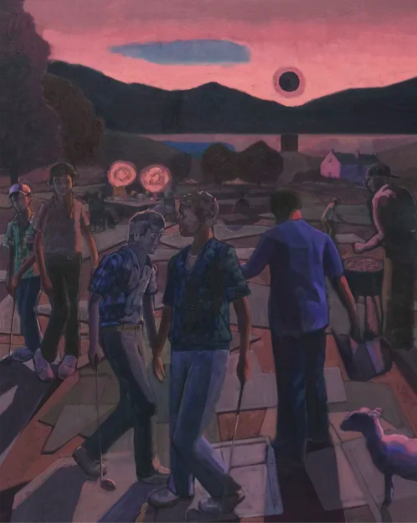
Ed Saye, Unheroic, 2025
(photo: E Saye)
In Between Days
The last picnic of the year, a final mowing of the grass, a wordless gathering around an ancient tree, a lonely smoke perched atop a familiar stump. Each a secular ritual marking the last long days of summer, and each taking place on the very edge of town under the crepuscular light betwixt the setting of the sun and waning of its influence. These are the subjects of Ed Saye’s recent paintings. The English middle classes about their leisure in a constant state of in-between-ness. After work, yet before returning home to draw curtains and lower blinds. They tend their lawns and barbeques because they are tenders rather than designers or builders; they are worriers as much as they are dreamers.
While the hour of the day feels fairly knowable (there are exceptions including a languid cluster of golfers gathered beneath a low hanging solar eclipse) the sense of whether these collected events are contemporaneous or wrenched from the closing decades of the last century is unclear, there are no distinct sartorial or technological clues. Along with their suit jackets, baseball caps, Hawaiian shirts and blue jeans, these are the people of the eternal return.
Most of the paintings depict a solipsistic everyman, though one divested of a need to confront his/her own mortality, they instead ponder the minutiae of their ordinary lives. These pensive protagonists appear just beyond our arm’s reach. They are a quarter-turn or a half-turn from us and we often look down onto them, not from the viewpoint of the divine, but more prosaically, as if from a small nearby hillock or rise, or more likely from the vantage of an upstairs window. This perspective, together with the way that the figures’ limbs only provisionally suggest a fully functioning anatomy, bring to mind the third person pov of action-adventure video gaming. As such, these ordinary citizens become an extension of each of us, a role that we might choose to play, as we look at and into the pictures. Our looking even anticipates a gentle swaying back and forth of the readied avatar, as if a mere tap of our keypad, or a thought-command telepathically communicated might cause it to continue in its task of lawnmowing, or perhaps to violently overturn the machine and to fall to their/our knees and weep. This then truly is the eternal return, because with every dwindling of the will to go on comes the opportunity to re-start the game and thus to conjure yet more meditative mowing under the fading spell of more long, last, summer evenings.
And if these avatars are an extension of us – simultaneously puppets of our desire and proxies for our despair – then they must also be sinuously connected to the person of the painter, whose brush (not to mention his penchant for hitting golf balls and for manning the barbeque) caressed them into their form and arranged for them the environment of their given predicaments. This is Ed Saye painting his life – or versions of how it might be – as he contemplates the end of his late-youth (characterised in previous paintings by a kind of twisted hippy dystopia) and his first tentative steps into early middle age. They are documents of the inevitable aging of (a) man.
This is not the soft swell of a burgeoning crisis however, as here amid this clipped and husbanded version of nature are familiar folk attended with a gentleness and with care. At times they might appear goofy (the desperate dad transporting his vastly oversized ice cream cone), or tragic (the lone smoker, stripped of his jacket as if he has just stepped out the back doors of a wedding dance), or confused (the man mowing seems to be headed in a different direction to his trusty tool), and yet none of these is bathetic, soliciting our lurid schadenfreude, instead they are each charged with a kind of pathos through which we empathetically engage. They are us – or like us – through their failings, their moments of indulgent introspection, their vanity, and their persistent hope.
A scent of the familiar
The compositions of these paintings are finessed through the feeding of increasingly more directive prompts into a generative AI system. Beginning with the instruction that the figure should appear ‘as if in an RPG’ and be located ‘in an English garden’ and be ‘operating a tool’, the subject of each future painting is coaxed into being. Ed is careful not to be seduced into allowing his AI facilitator to be too precise though. He stops short of it all making too much readable sense. It is often unclear, for example, exactly what the purpose of certain tools or objects are and how they work. Is the blue T-shirted figure in Hillside Figure [not in show] hoeing the grass at the edge of a path or is he attempting to liberate his wayward golf ball from a particularly gruesome patch of rough? And what exactly is it that The Smoker is smoking? These contingencies of creating, and axiomatically, of reading, are analogous to the very way Ed lays paint onto the surface. Form and space, light and place are tentatively described with complex hues of pigmented paste brushed onto a piece of stretched cotton fabric. As an image-making technology, painting is at once extraordinarily sophisticated and inherently flawed. Consequently, all elements of the image hum with the generosity of proposing an image in the act of its becoming, cognisant that in being looked upon (by painter and viewer alike) the clustered daubs cannot help but coalesce in our pattern-recognition programmed brains into something with meaning.
AI generates images by having an unquantifiably vast library of previously produced images upon which to draw. Every proposition that it makes is a bastard amalgam of images that already exist. Some images within this deep archive are so successful that their influence has already been felt on countless subsequent images, which are themselves active agents in this same archive. This compounds the likelihood that their shared compositional structures, spatial allusions, or figure types will float to the surface, once prompted, to be proposed as new image options for AI users. It is not unexpected then, that we feel the ghost of earlier iconic paintings as we look into Ed’s AI-composed images. The projecting grassy rise (perhaps a sloping lawn between flowerbeds) as a stage for the awkward man-with-mover dynamic is echoed directly in the lane traversed by Michael Andrews’ Digswell Man II (1960), Ed’s houses taking on the role played in the earlier painting by a dense scrub of trees, patches of deepest blue-black variegating the passage of forms from nearest to furthest. The sun-scorched meadow in which Ed’s overdressed men picnic in La Joie de Vivre has the same tone and rounded contour as the field in Andrew Wyeth’s Christina’s World (1948) wherein the titular figure appears to have woken, as if from a dream, to find that the day is over and that her house seems suddenly less homely than it once did. Even the set-apart barn crests a passage of a lighter, softer grass in the same way that the distant tree does in Ed’s painting. Look too at The Smoker and see how his posture leads one to think of Lucas Cranach’s witling figure in An Allegory of Melancholy (1528) – itself based on Durer’s Melancholia I of 14 years earlier – the storm cloud of rider-ed pigs and cows and horses shares its soft contour with the canopy of Ed’s near-silhouetted tree.
Am I really seeing a sparkling encapsulation of the history of Western painting in these paintings of Ed’s? Or is this just more hungry pattern-recognition on my behalf? You, my reader, must make your own minds up. I, for one, feel that influence is inevitable in the making of studio paintings even without algorithmic intervention. How much more so then, when the tool at our disposal has no ethics, sense of shame, or delusions of avant guardism or genius. Christopher Nolan (The Dark Night, Oppenheimer, etc) recently debunked the oft repeated criticism that Ridley Scott’s The Duellists (1977) looked too like high-end advertising to function as immersive cinema, countering that ‘Ridley took the language of painting and put it into commercials, then [he] applied it to features […] the reason it looks like a commercial is because he made commercials look like works of art.’ The point is that the world of images is made, fundamentally, from the world of images. The good and the great are in the mix and they cannot help but be constantly re-channelled through subsequent images, generated by AI or by the encyclopaedic catalogue of historic paintings that clutter the attics of all (good) painters’ minds.
And so (for this viewer), the edge-of-town, twilight ritual-ing of these paintings serves to conjure both the ordinary held within a quiet moment, and the great skeins of painting influence which weave back and forth though decades and centuries.
The centrepiece of this exhibition, Unheroic, is perhaps testament to this question of influence, consciously engaging as it does Stanley Spencer’s great Sandham Memorial Chapel mural cycle (completed 1932) and nearby to Ed’s home and studio. Where the tectonic of Spencer’s composition is a succession of echoing geometric forms (beds and tabletops, unfolded maps, shiny tea urns, graveyard crosses, etc), the ground beneath the feet of Ed’s pitch n’ putt-ers is tessellated with shapes which feel part sandy bunker, part flattened cardboard boxes (think Gustav Metzger in 1959), and part blank painting canvases turned face-down to reveal their structural stretchers. More telling than this formal homage to the chapel is Ed’s insistence that his protagonists continue to do ordinary things in extraordinary times. While Spencer’s cast of hundreds do the washing or check their kit or make the tea as many heroically tragic acts continue to be carried out on the battlefields of distant Belgium and France, Ed’s somewhat diminished ensemble wander back and forth to make the next putt, or in search of an errant ball, even as the moon passes directly in front of the sun. And in the moment of this eclipse, the two players closest to us, lost in the challenges of their modest pursuit, seem to perform a kind of dance of death, albeit unbeknownst to them. At this point in addressing the goings-on in the picture we begin to question the actions of the surrounding characters. Just to the right of centre, his back three-quarters turned to us, stands a figure with head lowered. In his hand is an object that could be the hastily re-folded map from the Spencer murals, or an unwarranted umbrella, or perhaps a kind of feed-can for the lamb which has diligently followed him onto the golf course. Beyond our secular shepherd (metaphors and allegories abound, but none are substantiated) we see the re-appearance of the suburban barbeque-er of August [seen elsewhere in this exhibition]. Diagonally across into the middle distance, the table of plein air picnickers (La Joie de Vivre) have once again settled themselves, out of place. It is all happening here, and yet none seems to have noticed the strange solar event colouring each of their modest idiosyncratic undertakings. In Unheroic the embrace of influence and the painter’s ability to nuance and mutate upon it, is clearly and playfully signalled, and it is almost as if the self-awareness of this action has caused the moon to temporarily obscure the sun. After all, while the other paintings [here gathered] whose engagement with influence is less pronounced, are tinted by the sun as it dips beneath the curve of the Earth’s horizon, this picture alone is affected by another planetary body obscuring the light. The effect is almost identical. The cause is fundamentally different.
An allegory of painting
I have discussed how Ed finds pause in the momentary rituals and solipsisms of the suburban everyman, which may or may not be a proxy self-portrait. I have speculated upon his choice to defer some of the early image-making decisions to an emerging machine-tool and how that system creates new possibilities from the rubble as well as from the cathedrals of the history of all previous images. I then arrived at a complex meta-work which seemed to gather many of the characters, actions and phenomena from the broader studio practice beneath a fleeting solar eclipse. I want now to play that journey backwards and see how it reads.
In Unheroic the figure with map/umbrella/feed-can, and with a lamb in his wake, casts a broad shadow directly down to the foot of the painting. This causes the shadow and the body to become a single sigil, a downward stroke of the pen, to which the blackened sun provides a tittle, collectivising a quietly insistent i. Is this then the I of the painter, seen here amidst the chaos of ordinary events, having found himself somewhat lost as the cosmic spheres continue to spin and orbit? The painter who has a tool – his AI – and yet does not (he cannot) wholly understand or control what it does; what it is capable of doing. This is not so different after all from his array of ‘legacy’ tools. A life in the studio is a continual reminder to oneself that the intention to mix a colour, to select a brush and to make a mark on a canvas is riven with so many contingencies that the mark we see in the wake of the movement of the elbow/wrist/fingertips is rarely the mark we anticipated at its outset. This is painting. Painting is extraordinary and it is catastrophically flawed. Painting is a verb. We do painting. We do it because we don’t know what the outcome of each action will be and because the consequences of those outcomes within the journey of its becoming is something continually new to be wrestled with and to be responded to. At the centre of it all is a painter in a studio. It is not a heroic occupation (or preoccupation), but it is a rich and a surprising one. And if there is success or visibility or deadlines for that painter, or whether there are none of those things, painters will still return to the strange peace of their studios to repeat the secular rituals of putting the coffee on, pawing through books and catalogues, canvas stretching, colour mixing, and finally wandering from the palette to the canvas to touch the soft wet head of the brush onto the receptive cluster of daubs, dribbles and smears made yesterday and last week and last year.
Vermeer’s great picture The Art of Painting (1666-68) has recently had its significance within that painter’s oeuvre disputed. In the paperwork left with the painter’s widow after his death The Allegory of Painting is referred to as the key work Vermeer studiously sought to retain, and which his widow Catharina struggled not to give up on being declared bankrupt. Until now, Art Historians understood The Art of Painting to be that work. However, Paul Taylor contests that this painting (of Clio, the allegorical muse of history) is merely a painting of the artist’s studio – albeit one of unquestionable significance - and not the elusive and exemplary Allegory of Painting. All this leaves a delightful possibility. That there is (or was) a painting even greater than the one housed today in Vienna’s Kunsthistorisches Museum with some additional clues to the mystery of painting. I am not seeking to make comparisons between what Ed makes today and what Vermeer left behind 350 years ago. But I do think that there is something of the beguiling slipperiness of what painting is, and why doing it matters, in this new exhibition of paintings, just as there is afresh in Vermeer’s Allegory upon which no living person has cast their eyes. You see. It’s not about the answers or the evidence. It’s about the persistence of not fully knowing.