< back to writing menu
white pages are unpublished or just thoughts previously shared on instagram (etc) / yellow pages are published texts
04/2022
[sic]: in praise of mis-hearings, mis-rememberings and mis-spellings
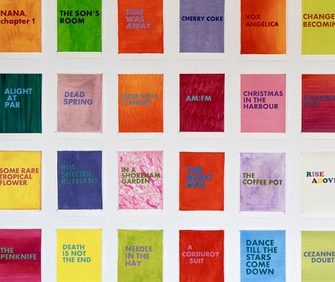
a text about my ongoing series of watercolours (beginning around 2001). This was written for a book that never materialised
Between here and there
Is better than either here or there!
Pavement, Conduit For Sale! (1992)
#404 (Knowle & Sissinghurst)
Knowle is the family home of the Sackvilles, as in V. Sackville-West, except that author and garden designer Vita couldn’t inherit this grand house because being an only child wasn’t considered sufficient merit to trump the fact that she was not a male heir. With righteous bitterness Vita left Knowle in search of a suitable home and eventually settled at Sissinghurst, where she and her husband Harold Nicolson created the garden for which she will forever be remembered.
Except that it isn’t. That it isn’t Knowle, I mean…
A friend contacted me through the DM (non-public communication) channel on Instagram a day after I had posted a slideshow-style video of a couple of dozen Ex Libris watercolours, set opportunistically (rather than with much thought) to a soundtrack of Julia Lee & Her Boyfriends’ hit The Spinach Song (1949). He wrote:
Hate to be a pedant but ‘Knowle’ should be ‘Knole’ I grew up near there. Unless you are making a pun on knowledge in which case I stand corrected.
No such pun had been intended. It was just a mistake, an error. Not a typo, I hadn’t merely hit the wrong keys on the laptop. I didn’t know that Knole was spelt without the ‘w’ which when included completes the monikers of the villages in the West Midlands and North Devon and the district of Bristol (here with its own citation in the Doomsday book as Canole meaning ‘little hill’).
I remember a daytrip my brother and I had taken while we were both studying at Goldsmiths (then Goldsmiths College) in the mid 1990s. We had journeyed by train to the deer park at Knole Park, Sevenoaks to spend some hours together in a place that neither of us knew. My brother later lived for a few years in Bristol’s Knowle West at a time when I was living in distant Dundee. In scribbling new possible texts for Ex Libris, and thinking about Knole and Sissinghurst and what they represented as a kind of much-abbreviated portrait, or biography, of Vita Sackville-West, and as I set those place names, first on my laptop and then in green watercolour on a field of pale yellow. Perhaps I was also thinking about my brother. I was reading Vita’s Knole through an association I was making with my brother and had typographically relocated his Bristol-Knowle with our stroll around the Kentish deer park. Wikipedia notes of Vita’s book Knole and the Sackvilles (1922) that it’s ‘rather romantic style is sometimes of dubious historical accuracy, but it is based upon full access to the manuscripts and books at that time in the House's collection’. Inaccuracy, it seems, is infectious, even by a kind of lingering osmosis.
#367 (Splinters of the Piquod)
On the same day that my pedantic friend enlightened me of the above error I received an email from Instagram’s complex algorithmic content-police saying:
We've removed the video that you posted at 8:12 am on October 29, 2021 because it included the following content: I Didn't Like It The First Time (The Spinach Song) by Julia Lee and Her Boyfriends. If you have permission to share everything in the video including the audio, such as the soundtrack or music, you can appeal the removal and have your video reposted. Remember that people should only post videos that they have the right to share.
This was a different kind of error, one of content and ownership. It would be foolhardy to claim the right to use someone else’s artistic creation for one’s own purposes without due recompense or permission, but to some extent all of the content of all of the Ex Libris watercolours belong to authors other than myself. Of course, I forge and nuance, mull-over and masticate upon strings of 3, 4 or 5 words until they feel ripe and potent to begin to be able to suggest something, wherever these phrases were found, and whether their sources are identifiable (to me) or not. I borrow the titles of novels, lines from pop records, phrases gleaned from conversations with friends. These are all authored (with a greater or lesser degree of finesse), but they are all also common; shared. They exist in the air. #175 (Dead Can Dance) takes its text from the name of an Australian neoclassical dark wave band. But that creative duo cannot surely have coined such a delightful phrase from nowhere? #239 (After a Journey) is the title of a great late Thomas Hardy poem (mourning the loss of his wife, underappreciated and under cared-for in life), but those 3 words are so commonplace that they must be uttered a thousand times a day, everywhere, by Hardy readers and the ignorant alike. #218 (On the Ha-Ha Lawn) is a scrap of a sentence salvaged from Radio 3’s transmission of an opera at Glyndebourne. Verity Sharp (I think) was giving colour to proceedings by describing the concert goers’ ritual of interval hamper-lunches in the gardens of the venue. A Ha-Ha is that picturesque invention of garden design which (by virtue of a hidden trench) both separates and unites a garden’s aspect. Without recourse to an unsightly fence, livestock can graze (picturesquely) on the meadows of the middle-distance without the risk of them invading the domesticated lawns immediately surrounding the house. The imperceptible gully cleaving (in both senses of the word) the landscape, is much like the grammatical hyphen that links the twin ‘Ha’s whilst retaining their distance, each syllable graphically segregated from the other. On the Ha-Ha Lawn is authored (by the radio presenter) but not in any overly considered way. Not in any way that it might be understood to be a stand-alone phrase, title of lyric. It is a conversational utterance, but no less brilliant because of that.
Nowhere in Moby Dick (1851) does Melville write the words The Splinters of the Piquod and yet this phrase can only be Melville’s. The Piquod is Ahab’s ship aboard which the delusional and hopeless pursuit of the White Whale is undertaken with globe-circling obsessiveness. The inevitable conclusion of this mission is the boat’s destruction at sea in one final attempt to snare the great fish. The splinters then, should any such splinters exist, are those atomised relics of this doomed vessel, imbued with a cultish power like those of the ‘true cross’ to be venerated in a kind of holy remembrance of human folly and hubris.
Except that it isn’t. In flicking one more time through my copy of Moby Dick just to ensure that Melville didn’t in fact inscribe those 5 words in this particular order, I realise that Ahab’s whaling boat is named The Pequod, and not as I have it, The Piquod.
#304 (Le Change est Magnifique)
There’s a plucky and breathy b-side to a single by English dream pop band Frazier Chorus called Le Change est Magnifique (1990). With the implicit romance of a francophile tongue, the singers collectively lullaby the transformative possibilities of champignons magiques. Having misheard the lyric (being not a French speaker) I first set the text as La Change… and upon realising this error (and with the bemused curiosity of the monoglot) I Googled the feminine Change to find it to be a former commune in the Dordogne region, 30 miles north-east of the caves of Lascaux. La Change, I suppose, is therefore undoubtedly a landscape quite magnifique. La Change however is no more. In 2017 it merged to become a part of the commune Bassillac et Auberoche. La Change is changed, it now has another name; the letters that are grouped to make the words that constitute its title are now other letters in other arrangements. To describe the village’s banal bureaucratic re-christening as I have just done, as the (re-)choreographing of a glyphic dance, might seem whimsical, but to my mind the re-naming action bears a soft echo of the analogue typesetter nimbly re-ordering the metal letterforms (slugs or sorts) in order to create new words, new containers, new signifiers and their hovering, attendant new associations, from the same base elements. #305 (La Change est Magnifique) due to my own bureaucratic incompetence is anachronistically given the number after its later counterpart, #304 (Le Change…), the instigator of the quest to find out what La Change might be. There are now 2 magnifique Changes within Ex Libris. Does it matter? Is one more correct that the other? In attempting to quote the title of a long-forgotten pop song I made a mistake – I mis-heard, I mis-remembered. I consequently mis-spelled. In so doing I momentarily achieved the pleasure of considering another place and another small transformation. Particular Ex Libris watercolours need not be rejected because they are spelt incorrectly just as they don’t fail some sort of qualitative assessment if the paint bleeds under the taped edges of the coloured rectangle. These pages are minor things, they do not require polishing or perfecting. They are a thinking place and a resource. They are a library of the borrowed, the shared and the mis-translated.
#452 (Jim Bob vs Hurricane)
Audiophiles beloved of online hi-fi chat forums take great pleasure in chastising woefully compressed recordings found on thoughtless, cheaply produced CDs. Alt-country troubadour Lucinda Williams’ fans are no different, praising the belated vinyl re-issue of Car Wheels on a Gravel Road for finally restoring the clarity of the lyric June bugs versus the hurricane so that it no longer sounds as if the singer is conjuring a boxing bout between Rubin ‘Hurricane’ Carter and some unknown, but plausibly named, Jim Bob. For me, I’m happy with either version. Neither lyric is devastatingly profound (why should they be?), and neither is any less vague or more open to possible flights of fancy than the other. The pleasure of the boxing version (irrespective of its authorial fidelity) is that it seeds a tiny allusion to Dylan’s flawed epic about the ‘wrongful imprisonment’ of real-life middleweight fighter ‘Hurricane’ Carter amid Williams’ song that has its own subject and issues. The myth of ‘Hurricane’ Carter and the (potentially) misplaced earnestness of Dylan’s campaign are both, simultaneously, things-out-of-place when they spark into life and then just as quickly burn-out in the mind of this listener to Lucinda Williams’ 2 Kool 2 Be 4gotten (1998).
Ex Libris is a project without end. Like any other non-definitive personal library, it is important that some of its constituent parts have been only partially read, that others are mis-remembered, mis-understood or are anachronistic, monochromatic or factually inaccurate. Some of the library’s contents may have been gifted from other enthusiasts or borrowed with the honest (though unfulfilled) intent to return. It should include bad translations, books so loved that the spines are broken and some pages are now lost, and a few for which the title (and/or cover) is enough to merit its place on the stacks or shelves. Books do furnish a room and libraries are reservoirs, portraits and compost heaps. They grow, cross-fertilise, endlessly reward repeated visits, and forge illogical and unauthored relationships one to another. Meaning isn’t only to be found in a sum of the close-read content of each home’s elegantly assembled and arranged library, it’s to be found too in the gaps, the flaws and in the strange event of finding Evelyn Waugh’s Brideshead Revisited next to Alan Warner’s Morvern Callar or Haruki Murakami’s Norwegian Wood alongside Iris Murdoch’s The Sea The Sea.