< back to writing menu
white pages are unpublished or just thoughts previously shared on instagram (etc) / yellow pages are published texts
01/04/2024
On Francesca Mollett in Present Tense
at Hauser & Wirth, Somerset, Jan/Apr 2024
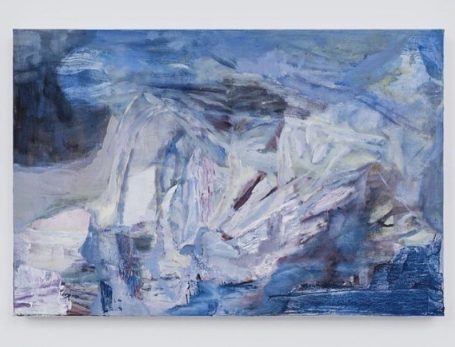
The best by far of the show of trendy bits-and-pieces down at H&W’s Somerset farm is a small pale blue picture by Fran Mollett. It seems ludicrous to suggest this is the best thing, it is the only thing here that sustains. And its quality catches you off balance having struggled through the galleries thus far.
Fran does this great thing in finding a way to think back through English Objective Abstraction - that couple of years of activity in the early ‘30’s - a sort of longed for utopian project distractedly wedged between the Euston Road and the School of London (of course V Bell and Omega had already got somewhere like this, only by another route). For so long this particular bit of historic London painting has been excised from the narrative because of the clarity of its desperation to pursue an elusive (European) ‘modernism’ whilst serving only to crystallise the uptightness - the manifest anxiety - of those British (and S African; Canarian) painters who clearly felt the winds of change, but couldn’t shake off the structures and strategies of their inherited values.
Actually, it was always the anxiety that was most interesting about Objective Abstraction. (Just as English Surrealism is about the driest surrealism there is, and all the more brilliant for it. Think of P Nash, he’s like those boring friends who not only tell you what they dreamed last night, but also interpret it for you). Those failings - that uptightness, that myopia - is why Nash is a brilliantly awkward painter (and why the gang-think of -isms, such as Surrealism, is so uninteresting).
Anyway… back to Fran in Somerset.
Now we’re okay with once-failed projects and oddball painters we’re all ready to think about how cuts and pulls and twists of the brush provisionally coalesce to propose shallow pictorial spaces and slippery surfaces and fragmenting apertures that are almost niches, or caves, or tabletops, or wilted blooms, or discarded quilts, or petrified animal remains, or old bags, or accumulations of candle wax . Images (yes, images…) that cannot be denied whilst equally not being able to be pinned down. Having thought about Fran’s paintings for years now (she is great and gets better and better) it is clear that she treats the looking-eye in the way the Sienese might populate a desert scene with episodes of the same saintly narrative simultaneously, appearing here and there; close and distant; before, during and after the key incident. Just as in those abstractions of time(s) and place(s), sense isn’t established in a linear way (such as reading left-to-right), but the purpose of the image is achieved through its coincident, constituent parts quietly inviting the eye back to linger again and again. The parts make the whole, but once the whole is established, it is the parts that once again delight. So delicately assured are the facets and the continuum that neither renders the other subservient. Both states are able to be fully present.
Like oddball-painters and painting-anxiety revealing itself within its touches, it is the fragmentary (making/unmaking) nature of paintings; the coalescing/dissolving of a motif, that speaks more eloquently about being in the world. For me, the rest of the show is merely painters with good ideas busily performing them for quick and easy (and transient) applause.