< back to writing menu
white pages are unpublished or just thoughts previously shared on instagram (etc) / yellow pages are published texts
2020-21
Natural Staking or Let's Make This Thing Together
published in Jacqui Hallum: Workings and Showings, Anomie / KPS, London (2021)
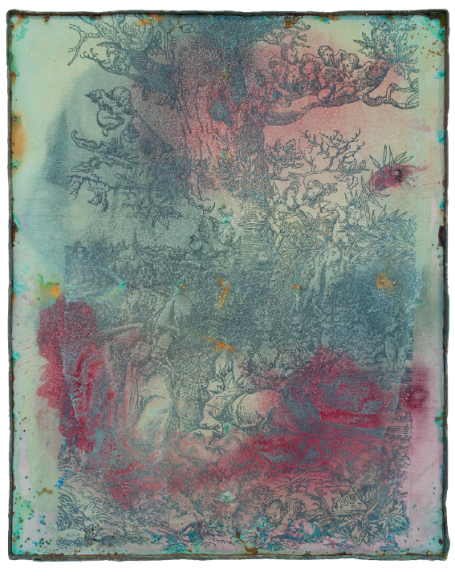
Jacqui Hallum, The Rest on the Flight, 2014
To blot, is to make varied spots and shapes with ink [...] To sketch is to delineate ideas; blotting suggests them.
Alexander Cozens A New Method of Assisting the Invention in Drawing Original Compositions of Landscape (1785)
Since Nature wants to do the sculpting, I will do the masonry and the architecture.
Joseph Ferdinand (‘Facteur’) Cheval (1836 -1924)
A negative is never finished.
Sigmar Polke (1941 - 2010)
In 2014, Jacqui Hallum exhibited the painting The Rest on the Flight in the exhibition I Cheer a Dead Man’s Sweetheart: 21 Painters in Britain at the De La Warr Pavilion. Live, humidity-reactive crystal-forming sulphates bloomed across a surface of pale grey and deep red stains, which carried a greatly enlarged transcription of Cranach the Elder’s woodcut of the same name [1509]. This ‘found’ image inscribed in small dashes and twisting lines across the canvas served to weave together the liquid abstractions of the under-painted ground, whilst also functioning as a quasi-armature for the growth and decay of alum and copper sulphate crystals.
Although each of the three elements that comprise the making of this work (stained colour field; transcribed drawing; crystalline growth) are independently conceived and executed, the painting (object) becomes a site where they cannot help but enmesh. The mutuality achieved by coincidences of material, and of form, is further reinforced by the particular narrative of the quoted image, the temporary rest of the Holy Family as they fled from Herod’s Massacre of the Innocents in Bethlehem, for Roman - occupied Egypt. Depicting the Christ child and his parents pausing momentarily between two states (home and exile; miraculous birth and the inevitable Passion), the image depicts a journey but does so by freezing the action somewhere that is neither one place nor the other. Both destinations are in play, both are relevant to understanding the betwixt locale (the Holy Family could, and according to the story, soon would return to Judea), and yet, neither state is the one currently occupied; neither condition is a conclusive resting position. The narrative is predicated on a dynamic transition from one to the other.
Amid the salty sea air that inevitably ingresses De La Warr’s Modernist beachfront galleries, Hallum’s The Rest on the Flight incrementally changed as its surface absorbed and fed on the damp atmosphere. As the crystals took on water, they spread and became opaque, tinting the image and recalibrating the relationship between passages of colour-information within the overall composition. The sympathy between the painting-object and the biblical story it portrays denied any possibility that Rest... might be sedentary, that it might behave like all ‘good’ paintings should, that it might be able to be addressed and understood definitively.
‘Poussin sur Nature’ was Paul Cezanne’s driving intent: to take all of the classical organising achievements of Nicolas Poussin, and to re-find them through a directly situated engagement with his surrounding environment. For this great and exacting recluse, pictorial devices were not to be dismissed (as if Nature and Culture are each territories that could operate exclusively!). Instead, learning through observation, from both of the systems, is synthesised in Cezanne’s picture - making. One hundred years earlier, Alexander Cozens had published his instructions for a chance - oriented method for representing the landscape in painting by the seeding of its image in a succession of unguided ink blots. [1]
Collaboration, exchange or co-authoring between multiple performing agencies – from the implicit behaviourisms of paint materials, to the possibility of weather to enact change on an unstable pigmented surface – are fundamental to Hallum’s studio practice. It is unsurprising then that her embrace of mutual-making extends into the space of the gallery. In complex multi-part ‘sheet’ works, decisions are incrementally negotiated as to where draped surfaces are allowed to fall, and where they must be pulled and pinned back, each move made in relation to the architecture and light of a given room. Somewhere between the paintings’ active dialogue with the contingencies of studio-making and their provisional installation-configuration in response to the shape and space of a gallery, other systems of exchange have been discovered. In an ongoing series of exhibitions, different facets and characteristics of the same works were brought to the fore as they were seen alongside works by other artists. These exhibitions challenge presumptions about what a solo presentation might be, finding a richer understanding through conversations with other makers’ objects.
The Rest on the Flight was almost the last painting that Hallum made on a canvas stretched rigidly around a rectangular panel. Shortly after the De La Warr show, she began work on new paintings for an exhibition with Belgian sculptor Tamara Van San at Standpoint, London and these – although still made with the same odd chorus of pigmented materials – were made loose on unprimed rough-cut artists’ canvas and cotton sheeting. Natural Staking became the precursor (although no one knew it at the time) of an ongoing series of 2-person exhibitions. The exhibition title refers to the horticultural practice of employing one living plant to form a scaffold (or stake) for another to grow up and through. As both plants are growing and changing, this method highlights the constant reciprocation between parties: the twist or sudden shooting of one plant will have a direct consequence for the other.
Small sections of Dürer’s woodcut Knight and Landsknecht [1497] emerge from the surface of the Natural Staking (DQ:SP) series of paintings, yet the titular Knight (and his attendant) seem to have been anachronistically recast as Don Quixote and Sancho Panza. It is the duality of these two protagonists as they each navigate the world experientially and imaginatively that provides a metaphor for the relationships between the areas of colour information that interrupt, animate and camouflage the image fragments. Just as the Dürer/Cervantes narratives provide a mutable frame-work for Hallum’s exploration of non-static painting, so too the painting substrate is itself a porous host for the stains and saturations, as well as the reactive crystalline growths that flicker and hum across its surface.
Working closely (though not in any kind of formal collaboration) with Van San cemented an understanding that surfaces cannot help but relate to one another: their disparate materials organise themselves into complex colour relations; they collectively receive and are animated by a shared (local) light.
Van San has a peerless feeling for colour and surface and how these twin characteristics activate space in a way that sweeps the person looking at (or with) the sculpture into a bodily complicity. Watching this happen was an empowering process for Hallum and supported the belief she already had in the potentiality of surface and of change to be framed and contained in ways other than by directive signs.[2]
In the street-facing window at Standpoint, Van San installed a curling knot of yellow-green ceramic, beside which Hallum suspended an upturned bolted khol rabi.
***
Between 1979 and 1984 Leon Kossoff worked closely with Ann Dowker on an etching of the bustling Kilburn High Road. To my mind, Outside Kilburn Underground is neither a series, nor a protracted process of scratching and burnishing - back in pursuit of a definitive image.[3] Taken as a whole, they become a complex multi - part work which seeks to echo the liveness of the motif in a medium that might otherwise be understood to be (literally) entrenched and static. On a particular day when he chose to install his easel opposite the station, the artist witnessed the rush of a crowd entering and exiting its ticket hall. Through the next five years, during which fourteen states (or versions) of this work were made, this motion became slowed – not to a standstill – but to such a protracted pace that the weight and form of each figure is only minutely altered, the image becoming affected with each iteration of the drawing - etching-inking-wiping-pulling of the print.
Exhibiting the first [1979], fifth [1980], sixth [1981] and eleventh [1983] states at Kingsgate Project Space, London, the clarity of city light, the countenance of passers-by, and the dominance (or loudness) of certain architectural surfaces ebbed and flowed as the viewer moved across and back, looking into each provisional capturing.
To the right of these selected episodes sat a foot - high stack of Hallum’s ‘sheet’ paintings, casually folded, glimpses of the colour and drawing of which could tantalisingly be seen. On other walls of the gallery hung single- and multi-part paintings.
The High Priestess mixed with Strength (Knight bestowing favour upon a King) has at its centre two rough, concentric circular stains, the extremities of which are like shorelines at the edge of a chromatographic experiment. Ghosting from this dry sea of green and burnt red are two figures performing the transaction described in the title’s parenthesis. Emerging from behind this principal sheet is a column drawn in dark green on acid yellow and bearing the initial J. Four letters at the foot of the column identify this motif as The High Priestess from the Rider-Waite-Smith tarot deck. This combination of elements becomes a wall - mounted pile; one drawn ‘card’ beneath and partially occluded by another, albeit a figure group from a very different source (Knight bestowing favour upon a King is an illustration from a Medieval manuscript). From the top of this pile and cascading down onto the gallery floor is a twisted ‘sheet’ whose images are too tightly wound to access.4 This fountaining spurt amalgamates, sublimates, the readability (illustrative agency) of the amassed characters, churning them into a fluid cacophony. If this spurt brings anything to mind, then perhaps it is the arching gush that streams painlessly and silently from the breast of the Lamb in the middle distance of the lower panels of the Ghent Altarpiece.[5] In forging this ephemeral connection, the concentric stains that charge the space between the knight and his king seem to become a latter manifestation of the aureole that marks the presence of Van Eyck’s Holy Spirit, depicted in the form of a dove. It is a huge leap to make... from a contemporary painting in a North London Project Space, five hundred metres from the spot on which Kossoff worked for five years to articulate a mobile depiction of a busy tube station entrance, to a fifteenth-century Belgian altarpiece! But, as soon as paintings (and etchings for that matter) are allowed to be untethered from the stasis of a priori form and significance, it is surprising where cross - cultural associations can lead.
From the possibilities presented through this exhibition, Hallum invited Phil Root to make a collaborative show for Intercession, Northampton, asking him to make ‘a ceramic vessel with no pre-ordained form or function’. Knowing Root’s catholic understanding of folk and studio pottery, and his own eclectic engagement with the possibilities of ceramics within fine art practice, Hallum wanted to allow her own openness to painting’s irrepressible becoming to infuse a joint approach to an exhibition.
The pile of potential ‘sheet’ paintings (which had by now grown in number) travelled to Intercession, Northampton and from this a provisional exhibition was selected. Those not chosen to be unfolded for this show remained in the stack, which sat atop a plinth in the centre of the gallery. This stack embodied not only the possibility of further selection and installation permutations, but fundamentally the live value of the forever-possible. Not selecting and hanging a ‘sheet’ (on this, or any occasion) does not mean stagnant moribundity, it means the exact opposite; it means latent fecundity.
On the floor, in the shadow of the plinth/stack, lay a vivid pink-orange-blue transcription of The World card from the same Rider-Waite-Smith deck. Above the left shoulder of the garlanded, dancing Sophia sat a rough lidded pot by Root, its contents unknowable and its surface pitted by a firing process derived from Bizen ware. Positioned on the outside of the stained wreath which encircles Sophia (her name meaning prudence or wisdom), was an ornament-scaled sculpture, Broken Rainbow II.
How did these images and objects relate? Were the objects offerings, or might they embody characteristics or attributes of the laid World card? ‘[Sophia] is dancing in the abandonment of complete victory, surrounded by a victor’s crown. The wreath is the equivalent of a trophy [...] The World card confirms that the highest achievements are being met.’ [6] If The World represents elation in the wake of success, then the pot surely is a gift, a token of gratitude. And the Broken Rainbow...? The World card presents both the height of achievement and the very last moment before the inevitable and bathetic return to the beginning of a circular journey. Does the fractured arch foresee this fall? After all, Noah’s great rainbow gestured God’s promise to never again wreak catastrophe on the earth; its haemorrhaging then implies no such pact.
Such an interpretive reading comes easily. The signs are present, and the system of tarot is one which invites readings between distinct signs. And yet this interpretation seems light and whimsical in the context of such materially complex surfaces. The World – to return to the logic of the tarot – is the culmination of the journey of The Fool (the wreath encircling the liberated body is often depicted as an ouroboros,[7] the circle of life and death that repeats endlessly). The following card is the inevitable new beginning of The Fool ’s revolving course. Connections are made by the intimate coincidence of Root and Hallum’s objects, but the implication that such a marriage cements meaning is foolhardy.
The third attempt in this series of proxy (or un-) solo exhibitions, this time with a selection of Berber Carpets, was borne out of a conversational exchange between Tamara Van San and Hallum in the preparation of Natural Staking. The Berber traditions of carpet making, they agreed, offered a valuable model for the studio processes of both artists: the material richness of those carpets means that the objects are read simultaneously as a map of their making, and as a negotiation of their geometric and organic systems.
The Berber communities of the High Atlas Mountains have passed on local traditions in pattern and design from generation to generation. The communal activity of making from these shared oral traditions, rather than from a written or drawn plan, allows numerous sensibilities, consciousnesses and dexterities to each affect the way the design mutates through the growth of the carpet. Each participant involved in the making represents an individual contingency.
For Hallum, contingencies welcomed into her process include weather, materials’ inherent behaviourisms, close and distant composing, bleeding through from one surface to the surface behind, and so on.
Through draping, folding and installing edge-to-edge both her own ‘sheet’ works and the Berber carpets, Hallum’s exhibition at Exeter Phoenix didn’t just propose an opportune coincidence of making processes each of which celebrates the impact of contingent collaborators. By making these objects live together, the exhibition temporarily proposed supra-works, where each discipline charged the other to reveal extraordinary flourishes arriving through multi-authorship, became the very success of the objects. The contiguity of the work of two disciplines meshed their distinctive objects, so that colour and line read through from a succession of knotted yarns to a transcribed line across a blooming ink stain.
As Berber carpets are made for the home, the marks of their domestic wear become colour areas in their own right, which in turn nuance the overall arrangement and dynamic of the woven rectangle and the carpet-‘sheet’ installation. Colour-fading by exposure to light, or through frequent use of a common route across a room interrupts, and at times erases, the already evolved and mutated design. The tendency in this wearing is for the discolouration to introduce paler tones into the coloured surface. As such, this lightening from within the material of the object through exposure to the universe outside of itself (the habits of daily transit through a house) echoes the reactive bleaching of the image that occurs in Hallum’s The Rest on the Flight as sulphate crystals release humidity.
***
These three 2-person (solo-ish) shows allowed (almost) the same stack of folded ‘sheet’ paintings to perform anew through each iteration of what could be a life-long exhibition project. It would be remiss not to (provisionally) conclude this account by thinking about the future of this pile of paintings without the artist, her studio and her exhibition-making strategies. Not only does Hallum encourage the gestation, growth and flowering of her paintings by naturally staking them to and with other mobile, living objects, she also intends for them to have long (or not so long) lives beyond her participation. ‘Living with a work of mine should be like living with a house plant [...] what interests me is sharing a space with it while watching it slowly change’.[8] The implication is that the painting, in its own materiality, acts and reacts with the cosmos as those two entities touch. In so doing they embrace their mutuality, their oneness. Writing about plant leaves, Emanuele Coccia describes the primacy of surface over volume for the evolutionary purpose of feeding from, and giving to, the ‘atmosphere’ [9] of which they are constitutional:
They participate in the world in its totality in everything they meet. [... As they do not run, they cannot fly, their leaves ensure that] plant life is life as complete exposure in absolute continuity and total communion with the environment. [...] One cannot separate the plant – neither physically nor metaphysically – from the world. [...] The plant is [also] the purest observer when it comes to contemplating the world in its totality. [10]
The exhibition Natural Staking allowed paintings to be considered in sympathy with gardening. Gardening is a mimetic interpretation of that which lies beyond the garden wall; it is a domesticated version of the natural world. Here too painting (especially multi-part, or multi-leaf, ‘sheet’ painting) can be thought of as being plant-like, as its thin surfaces, chemically and metaphorically, drink from and contribute to the atmosphere their skins inhabit and compose.
In recounting a visit to the storage facility of the Gemeentemuseum in The Hague, Dominic van den Boogerd marvels at a very changed painting. Jenny Kamerlingh Onnes, described her husband Floris Verster’s Schoorsteenmantel [1890] as ‘the best of his still lifes, with wonderful colour’. However, in pursuit of a fathomless depth Verster had mixed his paint with bitumen, the consequence of which is that those praised hues appeared now to van den Boogerd as a dull black:
The golden gleam of the mirror [within the composition...] is all the clearer, with the twisting branches standing out against it like black flashes of lightning. [... The mirror] does not limit the space but instead appears to make it larger. This has the mesmerising effect of an optical illusion.[11]
The implicit and unstoppable behaviour, borne of a combination of potent pigmented media, had become something Verster could not have imagined. That unstable stuff of its own agency gloriously enacts memento mori, and as it does so, it chimes effortlessly with the already wilting flower cuttings that once dominated the motif.
Giotto’s Arena Chapel frescoes at Padua [c .1305], before their 2002 restoration, manifested a perfect mutual parasitism. Despite TJ Clark’s tender and fastidious meditations on Joachim’s Dream,[12] what new significances might be brought to an image of spectral visitation by the blooming and bleaching of weather-ingress into the lime plaster? Clark is able to project through the bastard immaculacy conjured up by the restoration back to the frescoes’ hermetic early years, but he does so at the cost to the image-object in the world. The fissures and white-spotting that laced its dermis and epidermis before that cleaning connected the scene of a doubting and self-punishing Joachim to the fabric into which the image is literally drawn. Giotto’s heralding angel appears out of the blue, her legs below the thighs having not yet materialised into visible form; simultaneously (in the logic of pre-2002 looking) the blanketing blue itself dissolves into a worn and threadbare relic. One body emerges from another just as that second body (the blue sky) is on the threshold of disappearing; the angel and the oxygen performing a new ouroboros-like continuum.
The World card represents in tarot the apotheosis of success, and yet its next step is the re-instigation of the journey of The Fool as he travels once more toward a new success. The ‘new’ Arena chapel (fortunately) reverses this circular linearity, moving instead from immaculate perfection incrementally toward blistering and fragile ruin. This steady transition made in concert with all contingent factors and agencies, allows its (and all) painting to live; to be in a constant state of becoming. Though becoming what, who can tell.
***
[1] A Cozens, A New Method of Assisting the Invention in Drawing Original Compositions of Landscape (1785) republished as A New Method of Landscape, Paddington Press, 1977
[2] 'Double underlining’ is Hallum’s term for a reliance on too much signposting of a painting’s content or presumed meaning,
[3] Tate’s ‘artist-approved’ online notes counter this reading of the work, conventionally stating: ‘The plate proceeded through fourteen states in all before reaching completion in May 1984 [...] A parallel may be perceived between Kossoff’s use of etching in this way [...] and his painting method, in which the image is attained by a lengthy and repeated process of painting the entire image, obliterating it, repainting it and so on until a satisfactory image emerges.’ tate.org.uk/art/artworks/kossoff-outside-kilburn-underground-p77103
[4] The image on this ‘sheet’ is in fact derived from a children’s’ book illustration by Ernest Griset (1843 - 1907).
[5] The Adoration of the Mystic Lamb attributed to Jan Van Eyck, completed before 1432
[6] keen.com/articles/tarot/the-world-tarot-card
[7] Even the linking garlands of the Rider-Waite-Smith deck suggest the open mouth of the serpent swallowing its own tail.
[8] Conversation with the author at Kingsgate Project Space.
[9] ‘More than part of the world, the atmosphere is a metaphysical space in which everything depends on everything else’ in E Coccia (trans. D J Montanari), The Life of Plants: A Metaphysics of Mixture, Polity Press, 2017
[10] ibid
[11] D van den Boogerd, Great Temptations, Roma Publications, 2018
[12] See T J Clark, Heaven on Earth: Painting and the Life to Come, Thames & Hudson, 2018