< back to writing menu
white pages are unpublished or just thoughts previously shared on instagram (etc) / yellow pages are published texts
20/04/2024
On Jemima Stehli at Marlborough
and
Thea Djordjadze at Spruth Magers
Feb/Mar 2024
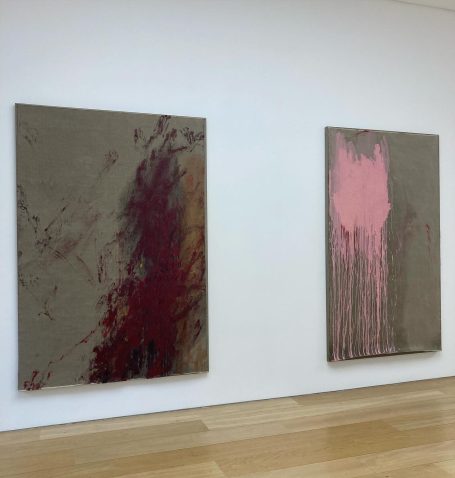
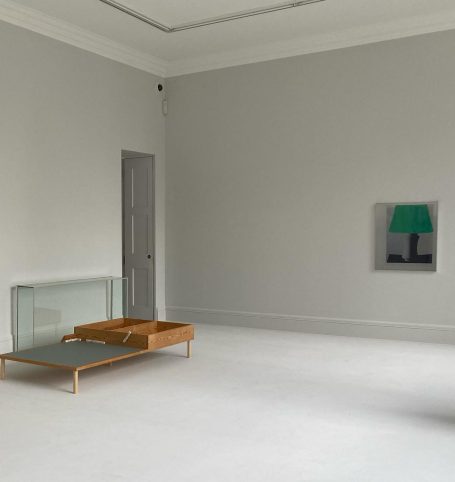
Having seen Mark Corfield-Moore at Goldsmiths CCA the other day (see previous) I realise that I was looking at that show through the lens of these…
A pair of shows from a couple of weeks ago that I’ve been mulling over since.
Jemina Stehli at Marlborough Gallery is a bunch of abstract paintings that even the current crop of RCA students would be nervous about making. They rely on how colour, as matter, is pushed onto a canvas - and that’s about it - except that how colour-matter reaches, meets and accretes, on a canvas is fundamentally complex. And now - today - even more so. We no longer simply have the ‘expressive’ and ‘ironic’ (distanced) possibilities of painting-making. Now we have:
- authentic-expressive (which can’t be entirely sincere)’
- ‘gesture-as-performed style (with too much evident pleasure to be merely cynical)’
- ‘reenactment as love or learning’
- ‘reenactment as legitimate or wilful ignorance’
- ‘painting as shooting-fish-in-barrel’
- ‘painting as pleasing-the-idiots’
- ‘abstraction as a liberated space for the pursuit of nuance’
- ‘painting as communicating-with-the-dead’
- ‘painting as a-part-of-wider-oeuvre (to be seen in the light of all the others)’
- etc etc.
And when we’re looking at paintings (like these) there’s no way that we can truly prise one approach from the hustle-and-bustle of all the others - cos, in reality, we, like this painter, are each (in greater and lesser relative proportions) always all of these possibilities, simultaneously.
So, these paintings that look a bit like something from Gutai or Vienna Actionism - two of the most angsty outliers on the 20th century map of acceptable painting possibilities (together with faint shadows of Joan Miro or Sam Francis lingering around too) - seem to want to speak of ‘serious’ body painting (body size and reach, the poking and picking of finger-painting, the staining of piss and blood). But they actually have real joys and questions and complications that stimulate and delay as all good paintings do. However angsty they look, I can’t really think about anti-establishment, primal, destructive ‘expressions’. The angers we might legitimately feel today are too righteous to call merely for paint to be flicked around as if painting righted wrongs. Maybe it’s partially because we no longer have any public spaces for real anger to be exorcised. Or that the expression of anger has its self become ironised. Galleries are certainly too compromised to be those hoped-for radical places.
The puckered, gummy blues, and the staining and dribbling yellows are good to look at. You can tell they are, because some paintings are clearly more active, engaging and rewarding than others. Some are self-cancelling. Some, on the other hand, pull the eye upward through a dense passage of matter to then scatter the viewing eye across an array of dotting and staining, less dominant moments. In others the left and right sides part-balance one another creating a zig-zagging looking, transitioning across the central clearer zone, gently scuffed and scarred as it is by hasty or accidental-seeming touches. These are exciting to look at. And the fact that some pictures are less interesting than others cements the certainty that when they are good, they are really good.
And all this good-for-looking-at/with about the paintings, rolled up with our self-awareness that we are each compromised and contradictory painter-lookers, make these works rich because they are not scared to risk getting it wrong, they revel in ours, and their own, impurity. They look great and feel untrustworthy. They toy with radicalism and they offer serious, sensuous encounters.
…
100 yards down the road was another show doing a very similar thing, very differently.
Thea Djordjadze at Spruth Magers is a cooler show, but no less (actively) contradictory and Janus-faced.
The works - as distinct units - constitute cool, certain, slightly aloof propositions. They feel utilitarian without revealing precisely what purpose they serve. Consequently, they seem blurred in time and space, as if somewhere and in some time their function is/was entirely obvious. As objects sparsely arranged in rooms, these meta-works dispel that sense of certainty-elsewhere, instead a kind of vulnerability ingresses where an aura of purpose is replaced with one of redundancy, or at least dormancy. The room-installations are all about the gaps and spaces that open-up around the retreating objects.
This ability to signal purpose and for those same objects, collectively, to foster self-doubt is a serious achievement. Thea is certainly a nuancing arranger of objects-in-spaces. She holds the tension of these possibilities with great poise and restraint. Furniture-like or display-like objects are able to find themselves again, anew, differently, when brought from one exhibition context into the next.
[I’m not usually a reader of press releases - who they are for anyway(?), but…] I was intrigued at the reference to Thea responding to the gallery’s ’genius loci’. When I watch those other twig-bending seashell-arranging ‘spiritual’ artists at work, I always think that their channelling of ‘other powers’ to achieve manifest harmonies (in pebbles and feathers and wine goblets, etc) is actually a bit like formalism - learned and styled, rather than ‘received’ from above/below (but then, I am something of a skeptic, especially when artists are involved).
But, I am up for this ‘genius loci’ when thinking about Thea (if, like P Heron on Claude L, we realise that it is very much a lesser god that dwells here). There is (obviously) something wrapped up in the conceit of arranging these works, aiming for a kind of sympathy with the space, whereby many thousands of other minutely shifted permutations might unlock a similarly compelling on/off-ing of active purpose/potency. Installing the unit-objects to make the room-works is a kind of chasing of an illusory ultimate in an endless field of possibilities, contingencies and variables. Thea achieves something taut and compelling, but she does so by allowing the thought (in the mind of the looker) to also consider any number of possible future moves, and these gather themselves to tease and test the illusion of robustness in the present mise-en-scène. Perhaps this nagging sense we each bring to the work is the disruptive sprite who occupies this ‘loci’?
Uncertainty amid the wrecked markers of specificity is the truest kind of being… y’know… seeing the other in the self, and the self in the other. Pretty much the delight and privilege of looking at things in galleries.
It’s a truly great show by a consistently brilliant artist.
12/01/2024
On Graham Silveria Martin's Closer Still
at Grove London, Jan/Feb 2024
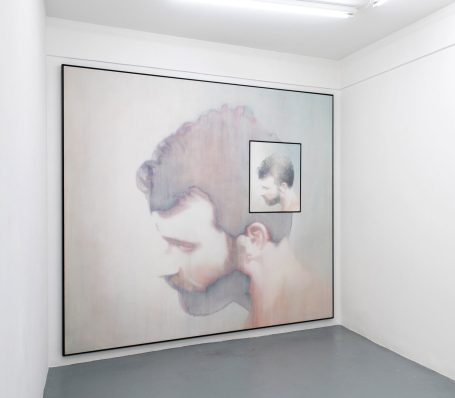
The exhibition consisted of close-up video stills painted with minute differences of light effect or lens crop or the smallest turn of a head. These paintings from a sequence of frames (each separated by a fraction of a second) from a digitised vhs copy of Steve Scott and Al Parker’s Turned On (1982) were installed in short bursts, one beside the other.
In this version, two transcriptions, so close they could even be from the same frame are shown, one within the other.
I’m always interested in cuts and inserts and the differences between continuous and contiguous surfaces, but this painting ramps things up. Not only does the smaller picture exist within the larger, but the smaller is nested within a fine-line frame, the space for which then is additionally cut into the surrounding picture, causing gaps on four edges to open-up which serve to both connect and sever the image. The almost bleached-out white light of the film, intensified by the wear of the re-played tape and the copying from one format to another, is given its opposite in the black gaps caused by the cold steel frames. These micro-voids then are spaces where decades and instants become confused and where personal biographies are collapsed into other cultural histories. Just as the interval between the frames of a film are almost imperceptible (see the paintings in gallery 1), so lust, loss, joy and tragedy are unavoidable in the gap within and between this painting within a painting.