< back to writing menu
white pages are unpublished or just thoughts previously shared on instagram (etc) / yellow pages are published texts
12/2025
The harder you look, the harder you look
essay in
[title tbc]
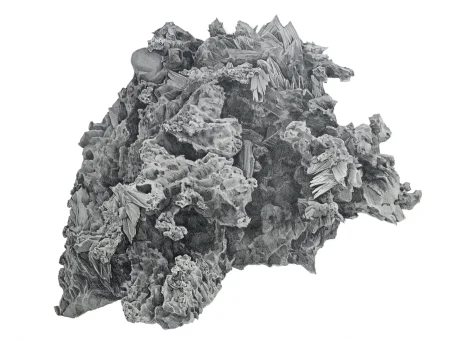
Johanna Love, Reliquiengarten staub, 2025
(photo: J. Love)
The harder you look, the harder you look
There is a sparkling contradiction at the heart of Johanna Love’s practice. Her strange triumvirate of subject, tool and method serves to expose a charmed gap where a gathered collection of spiritually charged dust motes, extreme close looking and exquisite drawing conspire to produce images as much of absence as of presence. In these asteroid-like images each idiosyncratic plane and fissure is revealed to the eye (as if for the first time). And, while we wonder at the tectonic surface, how familiar it is (in a fractal sense), we find our gaze being drawn deeply into the folds and clefts that tantalisingly suggest yet more inner worlds, inner spaces. Roger Fry wrote of Claude’s landscapes, that ‘some god is in this place. Never, it is true, one of the greater gods […] but some mild local deity, the inhabitant of a rustic shrine.’ And this feels true of Johanna’s works too. What lurks here however, is not solely the genius of place (loci), but perhaps also a spirit of the void.
The synchroneity of the advent of the first microscopes (and telescopes) and the advent of the artist studio in the northern Europe of the seventeenth century is unsurprising, in both cases close-looking sought to replace the divine-unknowable with the observable-fathomable. At the instigation of the Enlightenment project, art and the natural sciences were a singular occupation predicated on what might be witnessed by Man, and through which, it might become possible to remove the need for god(s) and superstitions to fill in the blanks. The microscopic dust particles painstakingly mapped in Johanna’s recent collection of prints are collected from the gaps and crevasses of the 1499 Bentlager Relic Garden housing the bones of 46 named saints and other anonymous relics. Today, these relics still inspire pilgrimages, both devout and secular. They hold the possibility for miracles, and they also locate the question of why such anti-rational faith might perpetuate even now. This print series helps us to see more, and to see even closer, yet nether the key to this sacred dust’s mystery nor a conclusive debunking of its spiritual potency becomes revealed. In fact, it is hard not to wonder anew at the cosmic splendour of our unknowable world, where the advancing tools of science serve only to excavate new gaps for new speculative projection.
Fundamental to the projects gathered in this book are the relationships of, and between observing-looking, drawing-looking, and (the viewers’) questioning-looking and wonder-looking. As such, we might even begin to extrapolate out and so question the presumptions and learned shortcuts that we each apply as we confront and engage with other art works. Knowing, it quickly becomes apparent, is an elusive and slippery territory. In Johanna’s works, the recurring motifs are particles of dust, the prevailing mode of description is drawing, and the usual scale of the image is many tens of thousands of times larger than the observed subject. And yet, the poetry of the images is as likely to suggest great boulders or meteorites, the works (at times) condense the protracted labour-time of drawing into the singular touch of an inked stone impressed heavily into a paper page, and it feels just as likely that the described objects are of a gargantuan, even cosmic scale as they are of the infinitesimal. Our a priori understanding of the projects is that these complex depictions are informed by electron microscopic observations of dust particles. But, like all good art, what the works are ‘of’ is rarely what the works are ‘about’. And just as rhetoric ‘about-ness’ crumbles amid the blooming of art’s mercurial strangeness, so too does ‘of-ness’ lose its prevailing and dominant role in signalling the project’s significance, its clustered meanings. It isn’t that we begin to doubt the images as being made from dust, rather incrementally we are able to hold simultaneous possibilities for what these images might also describe. The scale of the works is one way of expanding the multitudinous array of signified subjects, but hand-in-hand with scale is the amount of labour required to render each form, the sheer number of shading lines inscribed by the stylus across the page or stone. Each single line is an intentioned mark within a field of thousands of such lines, and while the intention is to capture and to reproduce what is seen, a mere line isn’t able to meet that charge, and so faith begins to be invested (by the draughtsperson as she is drawing) into the collective coalescing of the growing mat of marks, until at some undefinable moment on the journey of the work, a form is revealed. Creating descriptive tone and image from a humble line made in the movement of wrist and fingertips, is where art making begins to feel a little like one of Zeno’s paradoxes. These are drawings and prints of particular motes of dust, but it is also not possible for them to be comprehensively specific. They are chimeric grotesques of transcription, creative contrivance, and material agency. The images before us are subject to so many contingencies of touch and of technology that they are as much accounts of the vagaries of improvisation as they are of topographic verisimilitude.
What I have so far proposed is a way of thinking whereby a collection of works, an artistic methodology, even a model for viewing all art works, thrive and maintain their live-ness through an embrace of paradox. Infinitely small things are the size of planets, observational drawing is a method of inventing, the tools of science reveal only another window onto the sublime. William Blake’s Auguries of Innocence (1803/63) delights in such anti-empirical dualities (To see a World in a Grain of Sand / And a Heaven in a Wild Flower … et cetera), and it is Blake’s passion for line over chiaroscuro, and for process-metaphors over the economy of translation that I want to reflect back onto Johanna’s practice that we might see how the affect of these works relies so little on the certainty of knowing. Blake offers a particularly salient counterpoint to Johanna’s explorations among old saints’ bones as his life and work were unrelentingly entangled with angels and devils, extraordinary systems of belief and a complete disdain for all organised religion.
Blake despised oil painting, its mastery was too complex, the colours tended to sink, and fundamentally it caused all lines to dwindle. Oil painting too encouraged a tendency toward the flamboyant drama of chiaroscuro. Drawing and painting with line, in contrast, was an embodiment of ‘vital life’, it stood against deceit and trickery, and a ‘distinct, sharp, and wirey bounding line’ mitigated any tendency toward ‘weak imitation, plagiarism, and bungling’. Johanna’s dense carpets of lines do not share Blake’s concept or pursuit of honesty, but they do propose a way of seeing and understanding reality which allows for magic as well as technic, where ‘magic’ embraces and exults a sense of the ineffable at the heart of all things. Johanna’s dust mote / rock meteorite drawings are great clouds of single strokes of the drawing stylus, as such they are versions of the very primordial soup from which all written language emerged (and continues to emerge). If then, in looking into these conjurings of the decomposing skin cells of a lesser saint, or an interstellar rock held in perpetual orbit, we have a feeling for something which is extra- (or beyond the) linguistic, maybe too we sense a thing which is sub- (or before) language. Both extremes turn the technic world inside out and construct a norm which eludes all categorisation of state, family or hierarchy, in other words it denies the taxonomic imperative implicit in the Enlightenment march toward order and subjugation. It is helpful here to note that in making these vast works, Johanna is not wedded to making exact copies of the images prepared and presented by the microscopists. In the hours it takes to work across the paper or stone there are moments when she gives herself up to improvisation and invention, either (I am here speculating) because of boredom, a loss of concentration, or simply, because it looks better this way. The images and our relationship with them (through looking) become all the more vital because all of life is here, the facts and the successes as well as the weaknesses and the daydreams.
The printing method idiosyncratically developed by Blake to make his printed (and then hand coloured) books involved biting into copperplate the areas to be left white (or un-inked). This reversal of the conventional process allowed him to combine text and image on a single plate and epitomised his self-definition as painter and poet. He called this complicated process of relief printing ‘the infernal method’ whereby ‘corrosives, which in Hell are salutary and medicinal, melt[…] apparent surfaces away, and display[…] the infinite which was hid’. In other words, the ideas (or truths) expressed in Blake’s pages are innate and eternal and are materially attested in his metaphoric process. The copperplate is a surrogate for the man, ‘born like a garden ready planted’, and by excavating down into the metal (by means of bathing the plate in mordant) those truths become revealed. Later, after the dawning of the psychoanalytic age, critic (and latterly, painter) Adrian Stokes reframed this idea of material containing its own predestined revelation by denigrating the plastic art of sculptural modelling where material is built up around an idea, in favour of carving, which is able to reveal the stone ‘come to life’ through the vessel of the figure. In this process, which Stokes called ‘stone-blossom’, the stone is able to turn ‘outward’ and its stubborn otherness become manifest. It is significant that the key subject for Stokes’ testing of these ideas is the Christian temple of Malatesta in Rimini unexpectedly decorated with pagan iconography. The spiritual realm is conjured, and like Blake’s, it is equally confusing as to the roles, hierarchies, and presences of the gods. Stokes’ Cornish near-neighbour Ithell Colquhoun would embrace an even more direct animism in her account of the vital, ancient landscape of West Penwith whose standing stones channel a folkloric continuum of people and place. It is no wonder that Robert Smithson and Nancy Holt pilgrimaged here, and seen retrospectively from the present day, Colquhoun’s ‘living stones’ are a kind of Land Art minimalism, albeit one which the stones themselves were complicit in establishing.
Stone lithography elevates the drawn line in the same way that Blake painstakingly manipulated copperplate etching to achieve. The spaces around the drawing are made hydrophilic with the application of a weak acid and those areas’ capacity for taking the oily printing ink is stopped with the addition of gum arabic, leaving the fresh stone face (once the waxy drawing material has been removed) the only surface able to leave a mark once inked and impressed onto the blank paper page. Where Stokes and Colquhoun privilege the agency of the stone in its own becoming, in Johanna’s print process it is fairer to consider it a collaboration. She delights in the grain of the stone leaving its trace within the printed lines. Each linear stroke of the wax stylus is nuanced and given texture as the printing ink is rolled onto (and into) the exposed stone. Just as these images propose dust particles as asteroids and asteroids as dust particles, so too does the contingency of process allow one stone to become co-agent in the describing of another. The artist revels in the moments of improvision which allow these images to come fully into being, and these moments of flow are akin to the way in which the stone cannot help but give an ‘outward’ account of itself in the instance that the inked drawing touches the page. The life and liveliness of the stone becomes the live-ness in the printed work.
In a deliberate refusal to see these extraordinary images as a singular thing, to deny a concrete rationale and a clear throughline between source (dust of the reliquary) and consequent artwork. To confuse the very small with the very large, and to introduce material collaborators as co-authors of images through the complicity and closeness of process. So, this text serves to re-state a modest claim: that art practice is a peculiar undertaking and that artworks are unruly things. But things, nonetheless, which allow us to consider ourselves and our place in the cosmos because of the live joy cultivated from within their uncertainty. There is something ethically destabilizing about the very idea of predestination (even of materials, and especially when it tempers a responsibility toward human agency). But in our age where we are beginning to hypothesize new complex heights and depths to our understanding of being though the discovery of antimatter and the (as yet) unknowable substance that is dark matter, the Eternal Return implicit in a cosmic infinity is made richer and stranger by the holes and voids which hold the speculative totality together. Those voids are charged in many ways, and we diminish their bountiful possibility if we refuse to admit that here, perhaps, reside some mild deities. There is something inherently reflexive about looking, and art is a thing to be looked at. As we look out from our precarious selves we cannot help but find ourselves simultaneously looking back inward. As we gaze into electron microscopes, or into the dark of the cosmos, or into the grainy lines of these prints, we confront the ordinary and timeless mystery that the harder you look, the harder you look.