< back to writing menu
white pages are unpublished or just thoughts previously shared on instagram (etc) / yellow pages are published texts
08/2026
Jon Ridge: the glorious misalignment of stars at Finch Gallery, London
gallery notes
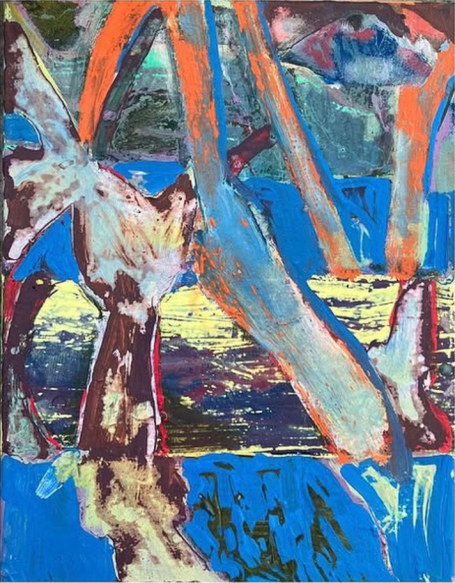
Jon Ridge, Arguably Trees, 2026
In this protracted moment of painterly surfeit – hordes of painters steadily, endlessly adding to a superfluity of paintings in the world – it is perhaps unsurprising that swathes of these polychromed rectangles continue to be politely gathered onto walls and into shows which each lightly re-trace common painting ideas, such as the relationship between control and chance, between the thing on the canvas and the canvas-object itself, between paint matter and the possibilities of image. The velocity and rapidity with which these (often interchangeable) shows emerge cannot help but belittle their stated ambitions. Marry that to an epic passivity or a disempowerment in the responsibility of looking. The repetitious conceptual parentheses shepherding each display has become a behavioural or methodological trope bringing little, if anything, to any of the assembled paintings, except for serving-up those image-objects before ‘viewers’ in the ersatz hope that they might (in that Duchampian / Greenbergian sense) become ‘completed’, and so, legitimise another return for those painters to those supernumerary studios in order to make more and more new paintings. And so it goes.
We’ve all been in those shows. Some of us have even initiated them, conscious or otherwise of the complicity this has in pacifying painting’s agency and urgency. Painting culture in London today is a ruin.
Painting-ruin is not an abandoned, picturesque, National Trust-kind of ruin. Rather, it is the kind of dilapidated edifice which its stubborn tenants refuse to abandon – either for fear of there not being anywhere else to make a home, or for some strange love affair with the failing project that their crumbling environment embodies – once the roof has come in, maybe it’s easy to convince ourselves that things can’t get much worse.
This might seem a counterproductive way to introduce a new exhibition of paintings by Jon Ridge, but, if we don’t at least acknowledge the context (of production and of dissemination) then we fail to respect that these paintings are now-paintings and not simply free-floating anachronisms.
///\ \
There are 6 or 7 deep piles of half- or three quarters-finished paintings lying around and stacked against the walls of Jon’s studio. There are a dozen or so paintings on the walls, or propped at the front of the stacks, which are either being considered for the next – even the final – touch, or which have possibly received that last mark and are now being checked and assessed to ensure that they neither contain too much or too little for them to be considered done. The studio is not a disorderly chaos, and the constant turning-over of the piles to find new connections and new possibilities is an established part of Jon’s effective methodology, but to the visitor (the observer, rather than the user of this space) it feels teeteringly on the brink of a kind of collapse into ruination.
The studio is the corner unit on one of the lower floors of a tower block (contentiously) marked for demolition along the edge of the infamous Thamesmead estate. Thamesmead is a late 1960s housing experiment built on drained marshes, formerly the site of the old arsenal, now nestled between Belmarsh prison, the second largest sewage treatment works in Europe, and the river Thames. At 11 miles from Charing Cross, the sprawling estate feels neither entirely in London, nor a natural part of the county of Kent. It is an island of idiosyncratic ideologies, ecologies and living histories. It’s buildings which are axiomatically of their time are either beautifully designed or are woeful banalities of their type – there seems to be no in-between. For those who have seldom if ever visited here, the estate’s mythology is a blend of failed utopic dreams, cinematic archetypes and news media hyperbole all projected onto a place where ordinary families continue to live ordinary lives. Many of these buildings are tired-looking, and despite the resistance of campaigning groups and the people for whom this place is home, there is a sense of inevitability that Thamesmead will go the way of the Aylesbury and the Heygate estates. If not quite architectural ruins yet, Thamesmead, like many social housing projects of the period have become ideological ruins.
It seems to me that the site where Jon’s paintings are made and the painting culture into which they emerge – both in their own way, dilapidated – provide useful clues as to why and how the best of them work, and why the fact that they work is so impressive. A sensitivity to these ‘problems’ too, charges the viewers of these paintings with a heightened responsibility in looking rather than passively endorsing them as things we think we know, as proxy Contemporary-paintings; sufficient, but with nothing at stake.
/ /\\\
I have alluded to the constant turning-over of the piles of paintings-in-progress within the studio being integral to the making of each. This churning, this ebbing-and-flowing of stuff, has echoes in the ways that coloured matter is continually accreted and then scraped, or washed, from the painting surfaces in their journeys of becoming. Jon has a vast and growing catalogue of ways to get the paint to behave in strange ways. Saturated emulsions are flooded over greasy knots of underpainting; still tacky slicks of colour are striated with hardened-bristled decorators’ brushes; hastily applied passages of acrylic are soaked and scrubbed to remove all but the densest contours. Paint in the form of pigmented liquids and pastes moves on and off the surfaces with a more fervent rapidity than in almost any other painter’s studio I know, and often, all that remains of this movement is the slightest trace. A consequence of this adding and removing of colour, this returning to, and resurfacing from the painting piles – the implication of the days and months between actions (dormancy) and the slow hours spent watching (latency) – is that the paintings remain remarkably thin. Despite their polychromatic complexities and their polyglot arrays of washes, scratches, dribbles, stains, and so on, the paintings do not rely on thick accretions of paint to index the succession of actions and decisions required to resolve each picture. Their material thinness conjures a feeling of the things having been weathered, of their persistent adding-to being continually countered by more elemental forces from outside the studio (in this case in the bathroom or on the balcony – a high-pressure showering-off; a good going-over with the scrubbing brush). Although both adding and taking away are, of course, actions of the painter’s intent, neither is fully controllable, and each relies on an equal proportion of happenstance and keen observation.
///\ \
The resultant deposits of these peculiar processes charge and charm Jon’s paintings, but that is not to imply that more conventional painting decisions and brush-marks are absent from or subservient within the final works. Coloured areas are radically changed, or minutely nuanced, by successive (often thinly) brushed applications through which we follow the gradual coalescing of harmonies and contrasts. These same brush painting-actions elucidate how the paintings’ structural dynamics evolve – its bands and fields; its jagged diagonals and stuttering horizontals; its clouds and pools and voids. Each painting confronts us as a whole, a totality, but soon, as we look into them, the fissures and gaps between one mark and the next, or the evidence of a poured area later having its edges tempered, allows us to intuit the months and moments leading up to its completion. And there is something about the provisionality, the instability, or the live-ness of these forms fostering a sense of their becoming which cannot help but conjure an equal and opposite feeling for their imminent demise, their coming unstuck from within. It feels that if we watch closely enough, we might be about to witness the paintings’ formal and material collapse.
/ /\\\
What, to my mind, weaves the threads of the place where Jon’s paintings are made and the culture in which they are shown, can be understood in the relationship between his processes and decisions (and how time plays its own hand in the paintings’ making).
We all know the truism: a paint-effect does not a painting make, and yet these pictures revel in their combinations and accumulations of curious paint-effects. We are all familiar with that flickering beauty revealed in a blooming stain despoiling the brutalist perfection of a cast-concrete façade, which quickly gives itself up as being a thin kind of whimsey; an unsustaining irony. Still, these paintings share some of the visual keys and clues of those stains. Jon, I sense, is determined to sail as close to the wind as possible in this regard, to feel, and to share the feeling, that at any moment this rickety premise of contemporary painting might collapse. Ruins, once the vital riposte to the evangelists of progress, are now a passive delight to iPhone-and-Instagram lifestyle tourists who continue to self-consciously curate their desired connectedness to an idyll beyond the reach of global tech. Paintings and painting shows too – of the type I introduced at the start of this piece – fill those same iPhones and social media feeds as well as the growing network of insatiable mega data centres. When, in 2016, Mark Fisher surprisingly endorsed Tory MP Louise Mensch’s snide poke at those Occupy protestors fiddling with their iPhones while queueing to buy coffee at Starbucks, he did so to tease apart the reductive binary of complicity and antagonism. Fisher reveals instead the complex duality implied in the cleaving of ethical and desirous drives brought about by full emersion within a culture of capital. And latterly, he glimpses the possibility for us to affect change from within (for where else can we be?). We must pursue a way to live beyond the compromised values of our present, but we must also accept how difficult it is to behave (to outwork our desires) as if those values have not already impaired the ways in which we are able to think and act. The systems for making, showing and looking at painting are in ruins. The housing structures which aimed to improve social cohesion through design have failed. Yet despite the temptation to see only compromise and hollowness in these situations and systems; to stop looking and caring for the snow-blindness caused by soft excess and the emptiness of uncritical production and commentary, some life persists within these crumbling ruins. The rich possibility of painting endures if only we (makers and viewers alike) each take the time to look, and to look with a quiet, slow and questioning discretion. Amid the mountains of rotten paintings produced and exhibited each month in this bloated city, it is still possible that something we need, is happening.
Yes, painting-culture is in a bad shape right now, but thus has it always been. It is our chronocentrist obsession which frames this particular moment as the very worst of times. There are certainly new and trying factors which shape the circumstances in which painting is made and viewed today, but it is mealy-mouthed to adopt the status of some kind of wounded victim when the things that we care about seem vastly overshadowed by more popular and more visible frills and affectations.