< back to writing menu
white pages are unpublished or just thoughts previously shared on instagram (etc) / yellow pages are published texts
09/01/2024
On Lisa Brice
at Thaddaeus Ropac, Paris, Oct 2023/Jan 2024
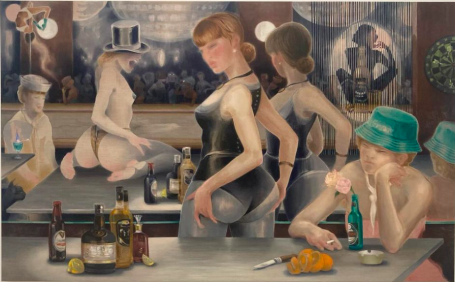
Until now I’ve always found LB almost impossible to look at. All that rhetoric… All that re-writing wrongs, dealing with omissions, re-centring ‘power’, etc; seeming to take the moral high ground in all the right places. I mean… really…? Painting can’t do any of that, and those that presume it can, feel to me like good natured fanatics. Surely it’s the culture around painting (etc) that does that stuff. It’s doing it now (thank fuck) and it’s busy doing it with paintings new and old alike, with paintings with and without images. Making paintings as if painting might bring about an upset of values seems weird and delusional. Such pictures might meet and endorse the energies currently surrounding them, but they, like all other pictures, will find themselves equally exposed to all future critical, marketplace and stylistic twists that will continue to re-locate meaning again and again in relation to our shifting ideological sands. And because LBs paintings seem (with a superficial glance) to be clever assemblages of smart, bathetic quotations of A-list european paintings of the end 19th / start 20th Cs, it’s almost impossible to look at their painting surfaces because our tugged forelocks keep getting in the way.
But this Paris show is fantastically brilliant. I am truly a convert.
Smoking is such a brilliant motif within painting (see Paul Becker, Ruth Root, etc) - it’s glamour and romance is anachronistic to the point of feeling sophisticated in a teenage-y way. It works (as a device) by being wounded by time. There are bits of anatomy too that are unexpectedly blunt and heavy (usually in painting anatomy needn’t matter at all, but here the fudged foreshortening and weird dead zones (which lurk at times) between thigh and torso ensure that all of it is put back into play).
These bits - the cigarettes and the odd bodies - charge the paintings because there is a flickering exchange between what convinces and what troubles. And because of the non-uniformity of function, it collectively all feels on edge; it’s alive.
The direct quotations (Manet, Knight, Courbet, Vallotton, etc) - played-with, are a bit like the duff bits of anatomy - clunky and a bit joyless. The less specific echoes amongst them (Manet’s array of glassware used in his late flower paintings - here it becomes a beer bottle; the painterly spatial convention of the drawn-back curtain - here it replaced by an insect-repelling strip curtain; Manet’s casually discarded secateurs - here we are given a pairing knife, lying blade toward us… etc), these are more generous, and they nuance the stiffness and directness of the other riffs.
There’s a palimpsest of the seated smoker from Vallotton’s ‘the white and the black’ seen through that same woman’s diaphanous dress as she now stands and paints. I know that I am supposed to think about her agency, but actually, it’s the simultaneity of the twinned body that is what’s really worth looking at. The now standing painter remains ghostly, becoming strong and solid only around the throat and jaw - it’s not the one that was (previously) the other that is exciting - that’s merely ‘an idea’ painted, it’s the coming-together of each in (and through) the act of painting that is amazing to keep looking at.
There are so many great bits and so many gassy and shifting and blushing spaces and surfaces, all painted in the thinnest possible stains. It’s utterly beguiling, hypnotic and - yes - smart and funny too.
Maybe the lesson when looking at painting is look harder. Whatever you think the painting is ‘doing’, if it’s good, it’s also doing something else too.
And let’s not confuse painting and ‘Art’. Art is the industry that surrounds painting and the lens by which painting is seen at a particular moment. Painting is a strange habit that people continue to do on their own in lonely rooms. Most of which never gets seen by anyone else and is none the worse for it.
And let’s, where we can, be sure we are changing the shape and content of what is seen, discussed and valued in and by the instruments of ‘Art’.