< back to writing menu
white pages are unpublished or just thoughts previously shared on instagram (etc) / yellow pages are published texts
07/2020
Neil Zakiewicz at DomoBaal
exhibition publication
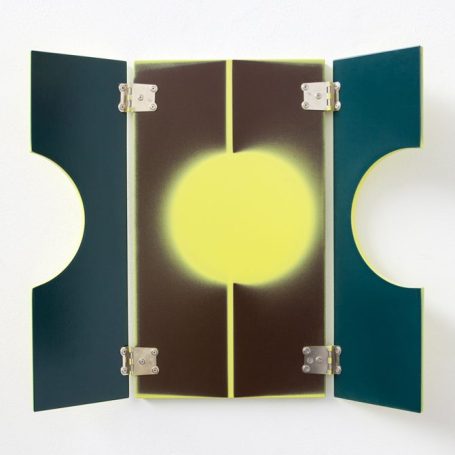
Neil Zakiewicz, Aufgeschlossen, 2016
(photo N Zakiewicz)
Leaving the door ajar:
why being open and closed is better than being either open or closed.
There is something awkward about Neil Zakiewicz, about the studio. Folding screens are not constructed from panels, but from full size doors, in the range of widths that are commonly available off-the-shelf; his industrial paint finishes are not uniform and hermetic, but colour areas bleed and seep into one another through impromptu stencilled edges. There is something at the heart of his process of making which insists that interest, possibility, liveness, are not only found in the scuffs and scars that are the patina of daily life (wabi-sabi) but can be introduced into the most unlikely objects, at the very start of their becoming. Liveness needn’t be a profound contemplation of mortality as manifest in the idiosyncratically worn (in the midst of life we are in death, or the other way around, etc.). It can bubble-up as an ineptly told joke or a misplaced good intention; a meeting of bent-intention and strangely receptive host. Hollow-core doors and cellulose paints are dumb stuff, but I don’t mean that Zakiewicz makes funny sculpture and paintings (and objects which exist somewhere between sculpture and painting). He’s not a gag-merchant. His objects don’t make us laugh, but neither do they solicit love and tenderness, or engender empathy and pity. How then do we feel when we are with them?
Zakiewicz chooses unprepossessing places to begin. He could start with real rubbish; discarded trash or pound store crap and transform these objects into things of transcendent beauty. A kind of reverse-bathos. He doesn’t. He starts with ordinary doors and ubiquitous paint finishes and transforms them into something almost brilliant. The gap between ‘almost’ and ‘completely’ becoming the intangible aureole enveloping the object, and the fertile territory which we navigate; constantly checking our own thoughts and reactions against the object. If these constructions were brilliant, like Tony Cragg and Donald Judd; or if they were actively anti-brilliant, like Rachel Harrison and Isa Genzken, we’d know how to deal with them. Instead they choose another path, a path that even Robert Frost couldn’t see because it rides roughshod through the pretty yellow wood, ignoring the competing conventions of the greater and the lesser travelled options.
Zakiewicz’s raw materials and processes are sourced on industrial estates, not in art supply stores. DIY outlets; panel benders’ workshops; car spray shops; ironmongers, these are his hunting grounds. And, in these places he finds things, and ways of doing things, that might open up new possibilities once they aren’t bound to the function with which they are associated. When an odd and underused cabinet hinge falls out of production, Zakiewicz bulk-buys the remnants. When his regular sprayer begins to express frustration at the artist’s unconventional instructions, he undertakes to learn industrial spraying himself, just as he had previously taught himself ceramic pipe extrusion. The industrial (with a dull whiff of the 20th century; a pre-internet of things-industrial) is the zone from which Zakiewicz’s studio feeds. Sculpture and painting are not outsourced to these workshops, the studio incorporates (as in in-corpus) industrial processes and the studio transposes itself back out into these places. The proto-sculpture (or painting-in-progress) as it transits to-and-fro becomes, synecdochally, the studio, and continuously absorbs processes and accretes skins and appendages as it goes. This is not the dreaded post-studio condition, that smug proposition by which artists, by virtue of the fact they have ideas (!), could rid themselves of their withdrawn making-space and act and react, on demand or unsolicited, anywhere in the wider world. This is studio as collector of anachronistic technologies; studio as cabinet-makers’ workshop; studio as mobile object; studio as viewing room; studio as testing ground; studio as ungodly chapel for the union of discordant and oxymoronic logics; studio as finishing school for the almost brilliant. This is studio as plain awkward.
Aufgeschlossen (2016) is a simple wooden relief, uniformly sprayed hazard yellow, with a vertical linear cut and a circular hole at its centre. The hole reveals a second surface, painted yellow in the same spraying action. There is something of the white reliefs of Ben Nicholson about it, but there’s also something of the bathroom cabinet about it too. The hole, being in the place where a mirror should be but isn’t, offers itself as an excessively oversized finger-pull. The front face of the relief comprises two doors, or flaps, and the finger-pull hole crystalises the feeling that these are to be opened. The title, meaning ‘open-minded’, signposts this action too. The viewer is on the threshold of becoming an operator: There is a surface below (within), and there are two hinged flaps which are partially enclosing and concealing that second surface. There is a hole, and the simplest action of inserting a finger and pulling, will open these flaps and reveal the second surface. But why would anyone want to open up this flat cabinet? The disk-hole gives enough away to suggest that there’s not much more to see. And yet still the urge tugs and teases. We have no memory of having this desire with a Nicholson relief, though we might be pretty familiar with the casual curiosity of wondering what lies within the cabinets in the bathrooms of unfamiliar houses in which we, from time to time, find ourselves. Oddly, the other part of the title connects this desire to pry with the worthy and noble quality of being broad minded; without prejudice, a characteristic that we’d all aspire to be associated with, we might even strive to be it. Does this yellow object offer a route toward this enlightened state? Can it? Might appeasing one’s base inquisitiveness and opening the flaps aid us on a journey toward being open-minded? Surely not! These doors must be a clunky metaphor, a model, of the type that spiritual sages and new age gurus are so fond.
Aufgeschlossen is one of an ongoing series of sprayed flat-cabinet, or hinged-and-sprayed works, the title of each playfully positing a different kind of open- or closedness: Now Open (2013); Open Day (2014); Close On Carnival End (2014); Undecorated Eye Mask (2015). But Aufgeschlossen seems key to getting a little closer to Zakiewicz’s broader project. Its Germanic name is a little out of kilter with those others in this series. Except that its title has likewise been plucked whole from some other vernacular source. The openness or closedness they each describe is specific to a given situation or descriptive context, and ‘aufgeschlossen’ is no different, it has just come from another idiomatic dialect. Titling proxy-furniture with appropriated utterances celebrates and reinforces these objects’ ability to make-do. Duchamp knew that making-do isn’t a reductive exercise, modifying so as to solve a problem conversely seeds the possibility of spiralling complexity. His Door, 11 rue Larrey (1927) served two perpendicular doorways, simultaneously. A super-efficient solution, except that when one entrance is closed the other is consequently opened, and vice-versa; closing is always also opening. Endlessly generative of new orders of meaning, Duchamp could take the extant, shift it, and then allow its new incarnation to live again, differently. From his studio, a chimney cowl (Pulled at 4 pins (1915)), a rack of coat hooks (Trébuchet (1917)), or a casement window (Fresh Widow (1920)) each breed fresh oddness and possibility out of ordinary domestic accoutrements. Stranger still, by means of being simpler, Boîte-en-valise (1935-40) presents 69 shrunken reproductions within a leather travelling bag. Readymades and other ‘originals’ are re-made, and as they are, the objects and the way we understand them is unsettled. This mobile-museum has the feeling of a portmanteau, when that word refers to a hinged suitcase, which when opened might become a temporary wardrobe. ‘Portmanteau’, however, might be a decent enough description of Zakiewicz’s flat yellow cabinet, Aufgeschlossen. Portmanteaux are those blurry bits of language that truncate as they blend (smog: fog that has some of the qualities of smoke). Aufgeschlossen (adj.) isn’t a portmanteau, though Aufgeschlossen (n.) feels like one, having the conditions and qualities of two objects (a relief and a cabinet), but neither in its entirety. Portmanteaux have something of the neologism about them too. They carry with them the ring of having been newly coined; introduced into the system (of language) latterly, after their constituent nouns and verbs have already coalesced around an object, or a process. They are words that upset and wrong-foot those semiotic connections, they create new meaning after the fact, and they only work with what already exists. The inappropriateness - or new-appropriateness - of a flat yellow cabinet embodies the same kind of awkwardness as Zakiewicz’s studio-blending of lite-industrial processes with design, ungoverned by function.
Oh, I forgot to say… with the door-flaps open, something else, something quite special is revealed. The bisected and articulated front face, within which the circular hole is cut, has served as a mask. In spraying the whole object yellow, a yellow sun-like image is made onto the otherwise red-brown surface within. Sun-like, because it glows. The masking performed by the closed door-flaps didn’t form an effective seal, and so spray has seeped beyond the hard contour of the disk and created a gassy halo around the conjured stellar body. The position of the (afore mentioned) cabinet hinges didn’t allowed the front face to close flush with the inside panel, and so the over-spray has ingressed farther to the hinged sides than it has to the upper and lower contours of the disk. The new sun within the flat cabinet radiates. A vertical yellow spray line subdivides the sun where the door-flaps failed to meet, and slithers of triangles appear along the top and bottom edges of the inner surface. These spills index the act of the object’s making, they draw attention to the idiosyncrasies of the hinges and of the not-quite-meeting flaps. And, despite how clearly this process and its consequences are narrated by these marks, the over-sprays cannot help also transforming the inner surface, illusionistically, into a further pair of doors, incrementally ajar, through which bright yellow misty light egresses. This vision of inner light is not sublime, it is not trompe l’oeil, it is a matter-of-fact mistake brought on by a misuse of industrial processes, in which something modestly marvellous has occurred. Opening the cabinet doesn’t reveal a great spectacle, it reveals a small, unfastidious and ultimately joyous event.
Untitled (Divider) (2015) explodes the opening and closing conundrum of Duchamp’s Door.. further. A zig-zag of four industrially sprayed doors have become a folding screen; a signifier of decorous modesty, although one with something of a heavy and ominous presence. These articulated doors are open, closed, and stoically ajar, all at the same time. The object brutally performs the function of dividing space, and yet the concealed territory beyond is left visibly accessible. The space on the other side of the screen leaks through this porous barrier. Heavy duty door hinges serve to excavate sightlines in between each panel, and two ample peepholes disavow any prospect of modest propriety. Just as in the flat cabinet works, these disk-like punctures have become stencils for the spray painting to charge the immaculacy of the surface behind, and in Untitled, where the object doesn’t present the temptation for the viewer to manipulate it digitally (as in with the digits), it is the eye that is drawn into its complicity. The transition of the airborne paint matter from one face to the other demonstrates the route of prurient, or merely inquisitive vision. And as the eye is tugged toward these apertures, it is snagged on their rough edges, and then, on what lies within. Just as these doors refuse to be open or closed, the circular cuts reveal another enclosed space, neither in front nor behind. The door-panels are hollow except for a honeycomb of cardboard. The revelation of this dark interior of cost-efficiency and material expediency raises a doubt as to the object’s mass – perhaps it isn’t heavy and unable to be manipulated after all? This revelation stirs no impulse to action however, the eye’s navigation of its surfaces, folds and cavities; its edges, gaps and interiors is sufficiently haptic and semiotically restless.
Among the newest objects in-and-out of the studio are what Zakiewicz currently collectively calls Metal Works (2019 & ongoing). Flat sheet steel is neatly doubled-over in a folding machine and then unfolded by hand. The objects are sprayed twice, once in advance of the mechanical manipulation, and then again before that manual action. The peeling back is a messier task than the industrial fold because the artist’s application of force is not uniform, and the object can only be grasped by his two (highly evolved, though not for this particular purpose) hands. The sluggish resistance of the metal can be sensed in the awkwardness of the bends and stuttering curves that constitute the sheet’s final form. And yet it is these very characteristics, this irregularity, which lend these objects a paper-like appearance. It is in the insistence of their materiality that the Metal Works begin to deny their own solidity, seeming instead to be insubstantial, soft and lacking in integral structure.
Like much of what Zakiewicz makes, Untitled (Divider) and the Metal Works refuse to be reduced to one position, or status, despite being utterly static. In their stillness is their liveness, and this liveness is the stuff that hums all around the objects, that ingress their recesses, that leach out from their cavities. They are always open, except when they are closed, and they never close. In cities, industrial zones lurk in the brownfield no man’s land between urban and green spaces, they inhabit redundant factory sites and accrete around canals and A roads. While 21st century industrial technology becomes atomised and ubiquitous, these zones dig their heels in continuing to supply the services and processes we had forgotten we needed. It’s no surprise then that these have become Zakiewicz’s surrogate studio, whilst also not usurping the role and significance of his artist’s studio. This is not a contradiction, and the works that result from his studio(s) are not paradoxical, they simply understand that being two or more different things at the same time is okay. They are awkward like that. The Germans have a portmanteau word for this; jein (ja and nein), perfect for those all too common moments when you find yourself looking at Zakiewicz’s sculpture and paintings (and objects which exist