< back to writing menu
white pages are unpublished or just thoughts previously shared on instagram (etc) / yellow pages are published texts
07/2020
The Bronze Mortar
an introduction to
Amalgam: Nina Royle Collected Writing
published by Folium, London & Kingsgate Project Space, London, Dec 2020
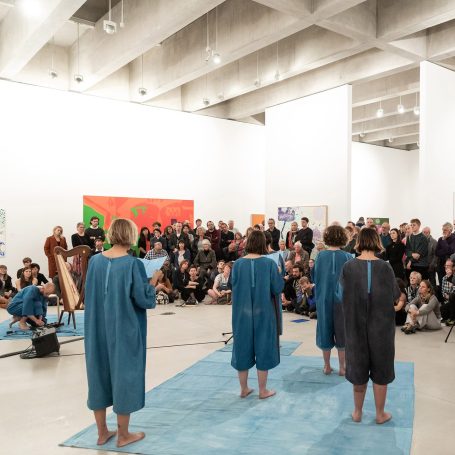
Nina Royle, Glaucous, Tate St Ives, 2018
(photo: Tate St Ives / Kristin Prisk)
In the Medieval and Renaissance galleries at London’s V&A Museum, there is a 16th century German mortar. Like an upturned bell, Wenzel Jamnitzer’s mortar (c. 1550) is decorated with four allegorical scenes embedded into a weave of medicinal herbs inhabited by life-like lizards, all cast with the finest skill in bronze.[1] Three of the scenes (based on plaques by Peter Flötner, c.1490-1546) tell of our mortal selves, whose looming deaths may only be assuaged through faith and hope and a stoic avoidance of the vice of pride. The final plaque bears a strange allegory of touch – a blindfolded and knife-wielding child has sliced his own arm. Touch is significant to this vessel as the user must firmly grasp the body of the mortar whilst grinding with the pestle, and – much like the danger embodied in the youth’s mishandling of his tool – nestled under the mortar’s rim lurks a threat manifest in a pair of life-cast lizards. The influence of Judeo-Christianity firmly relegated the lizard to the category of ‘unclean things’[2], so for the apothecary or the alchemist to use the mortar in the pursuit of knowledge, he must overcome all impulsive fear and revulsion toward this critter and touch its body.
The mortar’s decoration comprises three easily decodable allegorical scenes, alongside one narrative which must be unpicked more speculatively. These stories, illustrated as reliefs, appropriated and interpreted by Jamnitzer from another author’s hand,[3] are cast as one singular object, and co-mingle within a tapestry of facsimile flora and fauna. This mortar shares a similar tissue of multiple sources and multiple languages as Nina Royle’s performance texts, To Sirius’ Black Eye[4] and Glaucous[5], adapted and expanded for the page in this publication. Nina’s texts plunder and blend multiple sources. Glaucous juxtaposes Shakespeare’s account of Anthony and Cleopatra and the conquest journals of Christopher Columbus; William S Burroughs’ yagé-fuelled Naked Lunch and Rachel Cusk’s hermetically unyielding Outline. All woven through with a chorus of voices incanting a mantra for the cleaving open of time itself. The ‘user’ must be prepared to ‘read’ each element as distinct and as composite, where each component part creates a collage emphasising the possibility of continuity within a field of difference.
Mortars like Jamnitzer’s, embellished with life-casts would have been included in kunstkammer[6] (which, in the 16th century, hadn’t yet begun their gradual evolution toward the taxonomic storehouses of truth-like meaning we know today as museums). The kunstkammer (or wunderkammer), located within easy reach of both the laboratory and the botanical garden in the residences of the prince-practitioners[7], was a working resource as well as a display of precious objects to inspire speculation and wonder.
It is possible yet, to see this mortar as a synecdoche-wunderkammer, or a fractal-wunderkammer; a self-contained, networked display of different object-manifestations, rendered at a different size order. A similar methodology for forging a complex artwork, which is at once a gesamtkunstwerk, and a structure for framing and presenting other discrete artworks held within it, was notably enacted in Mark Leckey’s stutteringly eloquent The Universal Addressability of Dumb Things (2013, Hayward Touring)[8]. A space suit for a cat; a mandrake root; a 13th century reliquary; a music video by Aphex Twin; a quarter-scale clay prototype for a Nissan car; and a replica death mask of William Blake were among the objects arranged according to the baggy and porous categories of ‘Animal’, ‘Human’ and ‘Technology’. The sequence of exhibition galleries became an odd meta-collection display, the links between its artefacts being established as a kind of mesh, asynchronously.[9] Leckey’s web- browsing and harvesting of images into desktop folders[10] echoes the relational connectivity established by gallery visitors’ physical bodies moving past, and gazing through, provisional tableaux. In the accompanying catalogue, Erik Parker describes Leckey’s quasi return to a type of wunderkammer display:
Based on resemblance, analogy and occult signatures and [distinct from the modern era’s imposition of] taxonomy, strict filiation and rationalised, abstractly-defined relationships.[11]
From the Renaissance Wunderkammer, Leckey’s displays draw an understanding that:
The real magic of these collections [lay] not so much in the objects themselves, but in the crosstalk they [establish] and the dynamic way they [draw] the observer into the conversation.[12]
As the post-Enlightenment regime severed things from meanings and established discourse as the primary site for the establishing and transmitting of meaning, ‘crosstalk’ became the thing that was hushed-up. There was and is no tolerance for the occult hum of errant exchange when museum displays impose order and seek to define and disseminate truths through overarching narratives that privilege a singular voice.
Oh, the power of the voice; of the word… for good or ill.
***
Until the 1300s in the West, blue, as suggested by inconsistencies in its nomenclature, was not one of the definitive colours. Blue – as observed in the vastness above each of our heads – was understood merely as a diminutive of black, or of purple, as Nina describes in Glaucous[13] and in the notes for To Sirius’ Black Eye[14].
The texts To Sirius’ Black Eye and Glaucous therefore might be seen to address the same subject: blue-black. And, as they each unpack, muse, extrapolate, interrogate, speculate, cajole, juxtapose and unsettle what black and what blue are materially and symbolically, it becomes clear that reductive attempts to contain these entities represents nothing more than an imposition and demonstration of power. The names we give to colours are just more controlling linguistic devices able to be manipulated by dogmatic religions, colonising nations and history writers in order to suppress others. The possibilities of blue, and of black, are bigger and more complex than merely signifying (in the former) melancholy or purity, and (in the latter) the negative. Meanwhile the expansion of language(s) to newly coin these colours’ signifying nouns represents, conversely, a limiting exercise, one which, with sanctimonious authority, distinguishes and marks-out the self-proclaimed ‘developed’ from the so-called ‘primitive’. Nina observes:
The failure to pull colours apart, to spread them out like rainbows in seven, to pin them down and classify them with separate names like butterflies on boards, is a measure; a universal measure to measure the progression of cultures.[15]
Italian painter Cennino d'Andrea Cennini (c.1360-1427) authored the definitive manual of information, recipes and techniques for all things required for painting, from pigments and brushes to panel and fresco painting. In his instructions for the production of ultramarine, he details how the unwanted calcite (white) and pyrite (gold) should be removed from the raw lapis lazuli through a process of mixing a paste-ball of lapis, pine resin, mastic gum and beeswax, and then soaking it in lye (wood ash in water). Before this procedure though, the lapis was to be ground to a fine powder in a bronze mortar. In his Alchemy of Paint, Spike Bucklow notes the specificity of this vessel:
Bronze mortars […] were much more expensive than other mortars […] that the modern mind might consider to be equally suitable.[16]
He explains:
The golden colour of bronze indicates the sulphurous and fiery quality of the metal […] All the surfaces that the lapis powder touches are predominantly made of the fiery element. So, if any material is lost from the powdered lapis through sympathy[17] with mortars […] then it will be the unwanted golden pyrite, not the desirable blue particles.[18]
The form of the mortar is the apparatus for the breaking apart of the metamorphic rock, and the materiality of the mortar aids this through alchemic sympathy.[19]
The object of the bronze mortar, then, seems to be a fitting metaphor for the structure of Nina’s performance works. They are a container within which raw materials are pounded; within which received ideas are mixed together and broken down. These performances employ an array of address: incantation, poetry, lecturing, speaking other voices – modes of speech that are awkward and antithetical. Just as the activation of the pestle and mortar relies not just on the mechanics of brute force, but on that muscular task’s concomitance with the stone’s particulate structure, and the irrational science of alchemic sympathy. What happens within the mortar, and what happens in the co-incidence of audience and performer, mirror one another: each is a precursor to a further system of amalgamating and distilling. After the pounding, the powered lapis is formed into a composite paste-ball and kneaded; it is then soaked, and the pigment-rich liquid is drained off. Having given up themselves to the requirements of the performance, the listener absorbs the texts and later internally re-plays, tests and chews them over. The consequences of Nina’s polyglot utterances are what percolate into the cerebral cortex – that part of the brain most responsible for attention, perception, awareness, thought, memory, language and consciousness.
Ultramarine – the product of an elaborate, arcane ritual, means ‘beyond the sea’. In Glaucous, Nina muses:
In late Medieval Europe, ultramarine paint [was] the most expensive on the artist’s palette [and] desire for this stone [was] principally satiated by a set of seams that run through mountains in present day Afghanistan (once imagined a province near paradise).[20]
Ultramarine, a desirable rarity from over the sea; from a land that is mythically sublime, and – through a 21st century lens – politically contested. It can be too easy to allow today’s news media to scar this land and its people with a ‘morally justifiable’ prejudice, but – this text begins to ask – according to whose morals? Empire, exploitation and conflict expunge all associations with paradise, and as they do, they re-orient ‘the West’ as the new designator of good and evil, of ‘developed’ and ‘developing’.
Blue named blue […] robed the seeming dawn of a modern age; an age of man over nature; an age in which the coffers of capitalism were filling fast.[21]
The naming of colours was complicit in the dividing of those with power from those without. And that division, we might now see, is as arbitrary as the creation of blue (as distinct from purple, or grey, or green, or black) as a definitive, stand-alone category of coloured things; as one of the seven stripes of Noah’s great rainbow.
Nina’s text is a raw, compounded document; a tissue of quotations; an amalgam. It feeds us the familiar and the unfamiliar, woven from lines of emphatic and poetic words; given voice as sonorous declaration and as lilting chorus.
Like all amalgams these texts are conflicted and complicated. These text-amalgams are anachronistic and synchronistic; congruent and contiguous; they are scrutinising and panoptic. These text-amalgams are simple mixtures – one thing exists within and beside another thing. Yet in chemistry all amalgams are alloys of mercury, so we must fear that these text-amalgams too, have a powerful poison at their heart. In alchemy, Mercury is a principal; it is hylomorphically matter, and, in infinite proportional variance with sulphur (principal: form): together they constitute all things.[22] Mercury draws out the purest gold from ore through amalgamation; it does this equally when understood alchemically (mystically) or observed scientifically (rationally). Mercury is Earth’s solitary liquid metal. It is devastatingly toxic, and yet as dental amalgam it has filled the holes in our weakened teeth. Nina’s words, her amalgam texts, are of the mouth too. They must be spoken; they must be chewed over, and as the speaker and the listener collectively chew, we must each be aware that these mellifluous mouthfuls also contain the unpalatable and the venomous.
That other mouth-dweller, the tongue, that ‘pink meat […] wet like a slug’[23], has a role too. In Tongues and Mirrors in Mercury which closes this publication, Nina’s acupuncturist tells her:
The [tongue is] a chronic barometer of a person’s state of health. And its surface area can be read as a map, or a mirror, for the other internal organs.
***
Handing me a mirror he said, ‘study your tongue and tell me what colours you see’.[24]
In reading this book, the acupuncturist’s question lingers like the hum of ‘crosstalk’ in the gaps between the words, between texts.
Now… what colours do you see?
And what does it mean to see things that way?
*********
[1] These notes on Jamnitzer’s Bronze Mortar are informed by Virginie Spenlé’s text Wenzel Jamnitzer’s Mortar: Life Casting and Court Experimentalism in the 16th Century in Andrea M. Gáldy & Sylvia Heudecker, Collecting Nature (2014) pp.37-56
[2] Leviticus 11:29-31
[3] Flötner’s allegorical plaques are of course themselves re-tellings of much older stories.
[4] First performed at NICC, Brussels.
[5] Commissioned by, and first performed at Tate St Ives.
[6] Kunstkammer or Cabinets of Curiosity were domestic pieces of furniture, or more commonly rooms, containing an eclectic array of natural specimen, geological and archaeological fragments, religious relics, tools and works of art. The arrangement of these objects was speculative rather than ordered by type or function.
[7] A term coined by Bruce T Moran (1981) to describe German aristocrats who domestically engaged their wealth and learning in the pursuit of knowledge through geometry, astronomy, medicine, alchemy et cetera.
[8] A gestamtkunstwerk was the ‘total work of art’ in the 19th century, involving multiple art forms (dance, music, drama, etc). Here I speak of Leckey’s meta-artwork (which is distinct from a curatorial enterprise: Kathy Noble: ‘Your exhibition is positioned as an exhibition curated by Mark Leckey. However, the way I perceive it […] is that it is a Mark Leckey solo exhibition,’ Mark Leckey in conversation with Kathy Noble, The Universal Addressability of Dumb Things exhibition notes, nottinghamcontemporary.org (2013)
[9] Mark Leckey: ‘[When these objects come together] they make a form of mesh. I want them to create a form of energy between them – a system’ (ibid)
[10] ‘This exhibition began as a process of aggregating these things in a plastic, malleable way virtually, by gathering everything together in folders on my desktop and collaging them together.’ (ibid). The gallery installation mode allowed a trace of the flatness implicit in this image-harvesting to remain as certain displays were arranged to be seen frontally, set against chroma key blue or green walls.
[11] Erik Parker The Thing is Alive in Mark Leckey, The Universal Addressability of Dumb Things (2013) p.88
[12] ibid
[13] Nina Royle in Amalgam (2020) p.29-30
[14] ibid p.66
[15] ibid p.38
[16] Spike Bucklow, The Alchemy of Paint (2009) p.65
[17] Aristotle said that things have ‘a natural tendency to move towards their own special places or rest in them when there.’ Quoted in Bucklow, p.51
[18] Bucklow, p.65
[19] I use the terms ‘form’ and ‘materiality’ in relation to the bronze mortar, but as I do, I am confusing these terms with ‘form: Sulphur’ and ‘matter: Mercury’ (see below).
[20] Royle, p.45
[21] ibid p.46
[22] Where Sulphur and Mercury are principles, and the presence of each within the other constitutes all things. (Bucklow, p85)
[23] Royle, p.82 &p.85
[24] ibid