< back to writing menu
white pages are unpublished or just thoughts previously shared on instagram (etc) / yellow pages are published texts
04/2025
On gaps and influence (seventeen years, twice lived)
originally published by 41/42 with inserts by Nina Royle to accompany
Christopher P. Green & Charlie Duck 2007 - 2023
at hweg, Penzance, Apr 2025
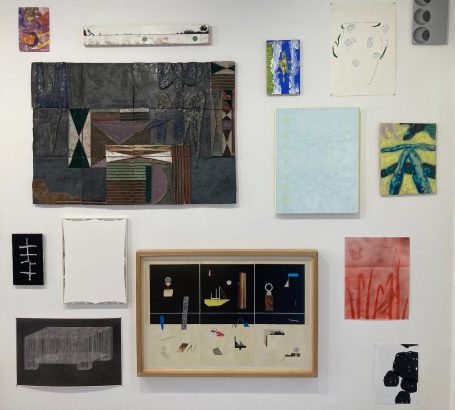
Christopher P Green & Charlie Duck,
(installation view) Christopher P. Green & Charlie Duck 2007 – 2023
On gaps and influence (seventeen years, twice lived)
What remains?
I once went to the studio of a much loved and respected painter and educator. There was no storage rack in the studio, just a modest pile of wrapped and partially wrapped panels tucked into one of the corners. I asked this painter where the previous works were, the markers of his circuitous journey of painting evolution. He replied, ‘I woke up one day and realised that the Tate were never going to offer me a mid-career retrospective, so I booked a skip’.
There are countless occasions where scholars bemoan some now canonical painter or other for strategic – or desperate – moments of wholesale destruction, the razing of all achievements and failures to date for reasons of anxiety, epiphany or practicality.
What really is lost in such fits of pique? A couple of hinterland PhDs… a few spots on the storage racks in the bowels of a half dozen museums… a modest step toward the completist’s paradigm of knowledge (or knowing-ness)? In most cases these singular or periodic clear-outs simply preserve the practicality (and affordability) of painting studios, and they lighten the burden inevitably placed upon each painter’s decedents, post mortem. I’m all for skips, bonfires, over-painting and the re-purposing of painting panels for other means [I came back to London once, following a protracted trip to New York, to find that one of my degree-show paintings had been used to patch a gap in the garden fence of my previously rented bedsit… sobeit, I thought].
What then of those oeuvres which by chance or design hang around studios, lofts or sheds long enough to constitute an overview? And should retrospectives necessarily be the preserve of the museum and the monograph (or recently, the commercial gallery with its revisionist and market-ready posthumous showcasings)? What happens when two painters press the pause button – so to speak – and collectively account for seventeen years of artmaking in a delightful (and bijous) gallery space more accustomed to displaying a quarter of this number of works in its exhibitions?
More and Less
The strange thing about a retrospective is that it is always partial. The catalogue raisonné is the definitive, complete works, and these only ever appear as books. If a cat. rais. is like a metalled road bridge spanning a vast river, then a retrospective is a bit like a scattering of steppingstones appearing here-and-there in dense clusters, and spread elsewhere at testing intervals requiring nothing less than a leap (of faith) to connect. To indulge this metaphor further, this irregular path of rocks comprises some wobbly ones which only just crest the water’s surface, and others which are voluminous and more surely-footed, allowing the artist/river-crosser a moment or two to re-group and assess the journey so far, and the passage ahead toward the – as yet invisible – farthest bank (aka death, or quitting, or similar). The wobbly stones are just as important for the crossing as the solid boulders. They mark the route too, even as they are imbued with insecurity and uncertainty.
Of course, there is something of all ruins about a retrospective too. We are as keen to wonder about what was once in the gaps as we are to scrutinize the parts of the edifice still standing. That said, we do not approach retrospectives quite like we do the poetry of Sappho, in the sense that the missing sections of these ancient scripts become over-endued with tingling specialness, the spectre of which charges the remnant verses with other-worldly, extra-linguistic possibilities.
Some readers might argue that absences within a retrospective are the consequence of a scholarly and selective curator, serving to present for us only the finest examples of an artist’s output. I don’t take that position. See the above notes on wanton (or otherwise) destruction. But think also about the availability and transportability of objects, the competing claims on specific works, the costs and the logistics of gathering the ‘very best’, et cetera. There was a much-anticipated exhibition scheduled for London last year which was cancelled when the (well resourced) gallery couldn’t meet the administrative costs of moving the paintings from the tax-free cocoon of their Swiss storage facility. Sometimes – it transpires – these objects are less interesting to their owners as artworks (available to lend and so expand the influence of, and accessibility to, that artist) than they are as promissory notes to some speculative investment. And there’s no museum in the world who can argue with that kind of perverse cash-logic.
To return to the image of steppingstones arrayed across a widening river. The gaps are vital to our understanding of an artist’s way-of-being with their long studio life not because of those stones/artworks that are missing, but principally because the gaps are where the world ingresses the hermetic construct of an oeuvre. Our restless river flows both in powerful torrents and in gentle, meandering eddies. It is subject to an irregularity of precipitation upriver, and equally to the geological and topographic conditions of the landmass through which it cuts. These influences of place, time and climate are ever-present to studios too. The works which are progressed, which emerge, or which are abandoned, are all coloured and shaped by the local, global and metaphysical concerns which permeate the minds and rooms from, and within, which art is made. Fundamentally too, each of these foothold-islands is indelibly connected to something we might call rockiness, or stoniness. The wobbliest and the surest stones both, are formed by the same geological processes as all other rocks, they are further shaped and conditioned by their immersion in the flow. So too artworks. These are formed within the continuum of all other artworks, from the deep past into the distant future, and they are shaped by the environments and atmospheres which constantly shift and change around them.
Lovestruck… I saw you…
In 2007 (or maybe it was 2006) one artist walked into the exhibition of another. Of course, these artists did not meet one another. Weirdly, people rarely meet other people at art exhibitions. Nearly two decades later that experience of looking at, of being with, the works on show, and those works’ experience of being looked at, has become the kernel for an exhibition of two evolving practices. Two studio-lives weave in-and-through one another (without actually touching) by virtue of the fact that some of those atmospheric conditions (summoned above) affected both studios. We are witnessing two paths of steppingstones fording the same river. The looking-artist recalls his admiration for the works being looked at (in 2007, or 2006), whilst acknowledging ‘it wasn’t work I was actively referencing or drawing any literal inspiration or influence from’. This might seem like a pretty unprepossessing start to a relationship. Except that the keywords here seem to be ‘actively’ and ‘literally’. These adverbs describe only intent, they fail to credit the insidiousness and lingering damage caused by ingress. [Here’s a personal aside: everyone – I mean everyone (except, of course, rich people) hates the paintings of Sean Scully, but increasingly I am having to admit to myself the influence of the window-cuts in his 1993 Turner Prize show paintings. I’m not sure I’d be doing the things I do in the studio now without having seen those.] So, let’s assume then that the looked-at paintings lodged themselves in the mind of the looking-artist, unavoidably, and in barely discernible ways the looking-artist had to deal with them at periodic moments when standing with brush (or similar) in hand before a painting/drawing/other which refuses to resolve itself straightforwardly. This is a version of what Manny Farber might call ‘Termite Art’, the quiet, lateral, surreptitious kind of art which incrementally enacts change and influence, as opposed to ‘White Elephant Art’ which takes up a lot of room, makes a lot of noise, but is essentially an egoistic project which serves only to maintain the status quo by replacing one big beast with another in the same mode.
Can we speculate this insidious influence further by considering the impact made on the looked-at painting by the looking-artist? What if the looked-at painting felt the scrutinizing gaze of the looking-artist and under those conditions began to behave in a certain way, and that the memory of this behaving became a logged condition from which it could never fully retreat, even as it appears to return to presenting itself in the way it did before? In particle physics we call this the ‘observer effect’. I know this sounds crazy. But really, it isn’t. It’s truer than anything else written here in this text. It’s true because artist-lookers are better lookers-at-artworks than almost everybody else. It’s no different from the arguable proposition that most of the best football pundits are players or ex-players/coaches. You just know the strategy, frustrations, effort and flair required to play the elite game if you have personal, lived experience of playing the elite game. Artists look differently because they have become proficient in seeing the panel/canvas/object as a total thing, and as a crystalline arrangement of many contiguous facets. They see it as play of languages and signs: of quotation, citation, appropriate and echo. And they see it as a relationship of figure and ground, and of shape and size. They read time as encoded in the trace of each dynamic brushstroke and in the painting’s stylistic anachronisms, as well as in the pace of the unfolding of its narrative. They read goodness, badness, ugliness, awkwardness and doubt. They see changes-of-mind and they empathise with protracted studio decision-making written into the tissue of marks. They see muddy colours and clean colours and how one mediates the other. They understand the material disquiet of a puckering blob and they can feel the relative viscosities of drips, flicks and splats. They can tell how stiff the paintbrush bristles were; how hard the lead, and they sense how tightly the painter was gripping the brush/pencil. They see all this in an instant, and they delight in drawing each of these out through durational and return looking. A painting/object so looked at is not the same thing when it is looked at without an artists’ experience. It can still be pretty good. It’s just a little thinner. And so, from here on this painting/object carries two versions of itself and these versions are irreconcilably divergent. The looking-artist has drawn out a whole realm of complexity and possibility in the object that until now was only there latently. You might want to argue that the painting/object is only ever a dumb thing, it can only be projected onto. But to take such a position is both pompous (presuming that all relations between things are forged and distorted only by an accumulation of human knowing), and it negates the very role and responsibility of the artist (working long hours in their studio nudging and testing the artwork this-way-and-that toward its eventual strange palimpsest of actions, erasures and re-actions).
There used to be a kind of creepy newspaper column where members of the public would write-in, hoping to be published, saying things like ‘I saw you on the number 36 bus. You got on at Oval Station and briefly met my eye. You wore a green coat. I was bashful. Let’s get coffee?’. Obviously, the true currency of these columns is in the thousands of readers scanning the paper each day hoping to find themselves the subject of a, possibly quite unhinged, desire. Just as all artist-looking is complex, multi-layered, and synchronous, all artist-looking is also a little bit creepy. Whether we admit it to ourselves or not, artists cannot help looking at artworks for what they can get out of them: What can I learn? What can I steal? This hungry, will-to-possess kind of looking often feels a bit like desire, like lust even. It is tinged with jealousy and all of the focus that descends like a mania when we see someone or something that pricks the bubble of our hitherto quiescent existence. It is unsurprising then that we either lean-in as close as possible to absorb every touch and decision inscribed in the surface, or we shrug ambivalently, not yet aware that an ember has leaped in through our eyeball and is now setting a quiet, slow-burning fire within, the devastation and possibility of which we may not realise for years to come.
Seventeen years later
Two painters didn’t meet in 2007 (or 2006), but the simultaneity of their studio lives since, the happenstance of their settling in West Cornwall, the vital and vibrant energy of hweg, has made this exhibition – this twin-retrospective – (almost) an inevitability. As the skeins of these two practices weave through this complex installation, they helpfully confuse developmental linearity, at times perhaps even authorship becomes uncertain. What is clear is that the fortuity of both artists retaining works made in each of the last seventeen years allows for us visitors to bear witness to time itself, encoded into objects and arrayed across these walls. Time appears here as a mesh of labour-time, rational-time, speculative-time and, importantly, time which runs fast and slow simultaneously, as well as backwards, forwards and sideways. Each of the objects on these walls embodies the duration of its making, it fits itself into the biographic flow of one-thing-happening-after-another, but it also forges trails of influence between themselves, out of sequence, and across the border which until now separated one artist-maker and the other. Fundamentally, this account of seventeen years – twice lived – happens for us viewers, in pieces, all at once.
‘Crosstalk’ is Erik Parker’s term for the non-hierarchical, pre-taxonomic, interplay between objects collected and displayed within wunderkammern. Proto-meaning fizzes in the gaps that the eye traverses as it scans and roams from one thing to another. The spaces are where the harmonies and the discords are made. In conjuring the idea of a retrospective as an array of stones, pebbles and boulders striding through the constant flow of a river, it is tempting to understand the river as merely the world, whose conditions shape and temper the making of art. Perhaps its time to consider the river’s relationship with the stones more reflexively. What if our metaphoric river is equally an outcome or an effect of the process of making these artworks (or a life’s work) too? Artists withdraw into studios. They accumulate countless hours among the tools and consequences of their making. They bring the matters of the world with them into the studio, and they think and build and reflect and destroy and re-make amid these concerns. Yet the porosity of the studio is effective the other way around too. The decisions and consequences of the studio leak into the world, not solely but certainly, though exhibitions such as this. The spaces between this archipelago of drawings, paintings, books, ceramic reliefs, neons, etc. ebb and flow with possibility. The intervals help us see the connectedness of things and they help us see the things themselves. Now is the time for us to hitch-up our skirts and to wade out a little between these stones.