< back to writing menu
white pages are unpublished or just thoughts previously shared on instagram (etc) / yellow pages are published texts
2021
Some People Dream a Lot
catalogue essay to accompany exhibition of the same name at Kestle Barton, Cornwall
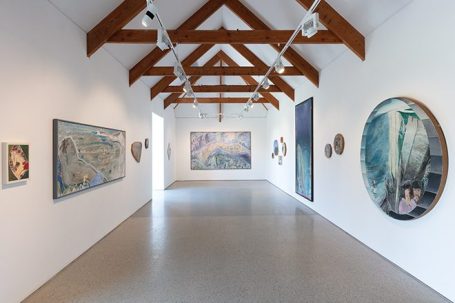
Jeffery Camp, Some People Dream a Lot, installation view 2021
Some people dream a lot.
Daydreaming is worthwhile but you must really force it and make it happen.
Beachy Head stands as the prelude to the Seven Sisters and begins a succession of rolling elevations that stretch from the southern tip of Eastbourne to the Cuckmere Haven and abruptly marks the eastern terminus of the South Downs. These vertiginous chalk cliffs are not like those of the North Downs though formed geologically in the same tectonic events and sculpted through millennia by the same weather and domesticating activities. Dover’s white cliffs are synonymous with a rusty idea of Fortress Britain and with jingoistic wartime pomposity. Beachy Head instead has a sense of fragility and vulnerability. It doesn’t present itself as a brute barrier but rather a crumbling edifice, it speaks of age and time as an old body does. It is at the same time, a place of exhilarating freshness, alive with verdant energy and new growth. Beachy Head is a landscape and a sensibility charged with mortal time, a mortality which embraces the life enhancing existential thrill of being within an environment of constant decay.
***
The soft spine of the South Downs, pocked with shallow chalk quarries and dipping down at Rodmell to accommodate the flow of the Cuckmere, is recorded again and again in the paintings of Vanessa Bell. The estuary at Cuckmere Haven, where the quiet river cuts exaggerated curves into the plateau as if hesitant at joining the salty waters of the Channel, is known to us by the tender pictures of Eric Ravillious. Beachy Head, in spite of its fame and extra-ordinary picturesque possibilities, belongs to Jeffery Camp alone. No other painter knew and can convey the sense of being on this gusty elevation where the land carries the walker up into the sky as if soaring, bird-like, out over the churning and crashing waves.
I came out to Beachy Head on a hazy morning in late April to feel the landscape I know so well through the paintings gathered in this exhibition. Between the chilling gusts of wind, the spring sun is hot on my neck. The thick, resilient grass is laced with violets and daisies, these latter blending with the chalk-tempered soil to give the green rolling hillsides a dusty bloom like the blue-grey growth that turns the skin of ripe plums silvery. Birds fill the air with a sound that rises up from among the grasses. A lark or a sparrowhawk occasionally take flight, but the ravens, magpies and (what birdwatchers would call) LBJs content themselves with darting on foot or in short, low level swoops across the ground. Peering over the edge of the land the ravens are in flight, hanging leisurely in the gentle eddies that draft up the cliff face, before diving back downward and into nesting holes dug excavated into the chalk. Flight at Beachy Head takes place mainly below ground level.
Attempting to stand where Jeffery stood as he made his preparatory sketches for paintings, I am forced to inch closer and closer to the cliff edge. Orienting myself by the profile of dominant outcrops and the pathetically diminished lighthouse below, it seems that the ledge or promontory from which Spectacular Drop (1972) was conjured is no longer there. It isn’t possible to stand far enough out to sea to glimpse the full verticality of the mid-distance stack distinct from the closer cliff face sloping up and backwards away from the plunging drop. And I wonder, was that vantage point even here when those drawing were made fifty years ago? Did Jeffery stand (safely?) on solid ground, now crumbled into the sea, or did he invent that impossible perspective? Did he dream the vista that such a speculative promontory might once have afforded?
Then without warning a few spots of rain, and my own speculative dreaming is brought to a sudden halt. Things change here from moment to moment as well as from age to age.
Painting is looking, recording and inventing. Painting is fundamentally the weaving together of these actions into an image which is complete and whole, and yet fragmentary and multi-facetted. Each brush stroke combines to become a dominant image, but each brush mark is always also the trace of a singular, small action of the hand and wrist. Painting is like the landscape; it is a complex cacophony of activities that leave palimpsest surfaces each one embodying the seeming contradiction of change within a static form. We live in between days; in between times. The past lives in us as memory, history, fable and longing. The future lives too, as hope and desire tempered by the base monotony of the sun’s perpetual rising and setting. The present exists beneath our feet but can only be truly experienced through its channelling of ages past and future.
***
Weather is a complicit protagonist in Jeffery’s Beachy Head paintings. When Jeffery paints the rain, he paints it as a saturating, unrelenting downpour. When he captures the wind, its ferocious energy tugs at coats and dresses and threatens to pull bodies helplessly over the cliff edge. When Jeffery paints the sun, he creates a hot, thick, stultifying air that is at once exultant and exhausting. The sun-drenched pictures fizz with the pleasure and memory of youth. They hum with a sense that everything is possible. They pop with verdurous life and drip with lazy, languorous delight. The sun is heavy and slow, the waves, far beneath, are dense and infinite. They recall English summers when afternoons dissolve into heavenly bliss and bodies refuse to expend any more energy than is absolutely necessary. Recumbent bodies become one with the grass, the soil, the earth; this very planet which spins effortlessly through a deep dark nothingness. Everyday trials and routines disappear in the hope that this one moment might become forever.
Some bodies rest and drink the sun’s energy, but other bodies touch and caress one another; they admire and indulge, they love and are loved. Like the birds and insects that also populate these burgeoning wildflower meadows, these bodies are engaged in the process of living even as the cliff into which they discretely nestle is steadily crumbling away to nothing. As the Buddha says: ‘The nature of decay is inherent in youth… in the midst of life [etc etc]’, so too, in the midst of death lies the flowering and eternal possibility of new life.
It seems amiss to speak only of the topographic decay of Beachy Head. This is a landscape and location painfully connected with tragic sadness, a place where lives driven to untimely ends come to step out over the cliff edge. Jeffery recounted ‘A policeman told me how many humans jumped, [until then] I had concentrated on the splendour of [these] vast spaces. There were twenty suicides that year’. Once told, this cannot be forgotten. In one of the drawings for Spectacular Drop a skull appears at the fulcrum of the image. This blunt signifier of mortality is left out of the final painting, but its spirit remains.
The sculptor Roger Hiorns commented on a work of his own entitled Beachy Head, ‘Beachy Head is where the land ends and where the land ends man.’ Humans populate Beachy Head and humans also become one with Beachy Head. They become the landscape and Beachy Head in turn, itself, becomes a body. ‘Like twisting hips in a petrified dance, these rocks turn in several directions.’ ‘When the beam of the lighthouse swings round, the cliff is like a bright nose.’ These notes show Jeffery’s feeling that the land is itself corporeal with limbs and bones and features. This is a body susceptible to the signs and effects of aging, and it proudly displays its new growth each year. Perhaps then it might be capable too of dreaming its own fantasies and being clouded by its own melancholies too.
***
Around 2010 (then in his mid-80s) Jeffery made his final great body of paintings, the Petalled Figures. The vital and vibrant blooms which cushioned the cliff-top bodies of the Beachy Head paintings re-emerged in garden borders and as cut flowers arranged within interior spaces. Manet’s last great paintings were flower paintings too, modest in scale and devastating in their fragile poise. The tradition of still life painting has always been one of loss, of the impermanence of life and the inevitability of death. But still life painting has always also been about present-ness; of the artist bearing witness to, and recording, the fall of light on the surface of the motif arranged within touching distance. Still life painting says: ‘all things will pass’, it also says: ‘I am here’.
Through the mesh of petals and stems can be glimpsed those bodies remembered from summers on the South Downs. The same figures now bend and recline and stretch amid a domesticated version of nature. Cut flowers have taken the place of the cliffs as location and as fluid metaphor. Both are natural forms, and both are subject to constant, incremental change, although the cut flowers manifest that change in days and weeks rather than centuries and millennia (in a cosmic sense however, both timeframes are infinitesimally brief). The youthful bodies stretched out in the landscape were on the cusp of something. Their youth cradled by and in opposition to the ragged age of the crumbling rocks. They were held in a fragile moment before adult life with all of its attendant worry and decay properly set in. Among the cut flowers, which at any moment will begin to fade, their youth feels eternal. This is the ghost of youth. Just as the curving contours and cliff face of the landscape became a body in its own right, so too these bodies become petalled, they merge and become plant matter.
***
Long before Beachy Head had become the leitmotif of Jeffery’s oeuvre, he made many paintings of the flat and unlovely coast at Pakefield, Suffolk. The architecture of those earlier pictures (the serpentine waterline curving up the canvas stutteringly echoed by a bank of grass-tufted dunes) allowed for his scrubbing and dotting brush to suspend broken dashes of colour into the painting only so far that they were tentatively held on the threshold of becoming symphonic, or otherwise dissolving into chaos. These were paintings which made themselves through the act of being looked at. Closeness and distance, figures, sea and weather gained a provisional definition as the viewer’s eye navigated up and down and across the painted surface. The image, the scene, the drama could never become stagnant or tired because it never entirely resolved itself into permanence. The viewer was complicit in willing the image into being.
Through the 1970s and 80s this patchworking of distinct colour-touches gave way to a softer continuum of colour. Fuller forms and a longer lyrical line, all framed by an inventive array of painted borders, settled the images into an otherworldly space. Jeffery’s inventive transformation of the subject (as opposed to its mere transcription) remained consistent, but the stylisation of the figure(s) and landscape were closer to late Derrain (by way of Masaccio and Poussin) than they were to the agitatedly fractured colour surface of early Derrain and his fellow Fauves. Although it is true to say that the dotting and scrubbing mode of paint application never waned, through the 70s and 80s the image was built up through many more touches-on and wipes-off, and in larger passages of closer colour-harmonies. As Jeffery aged, the hermetic image once again fragmented as the weave of coloured paint-marks began to be less tightly bound into one another. Perhaps this loosening of the relationship between marks and image was a conscious return to an earlier, more provisional picturing. Or perhaps it was a consequence of a gradual loss of fine motor control, or even of a deterioration of eyesight? (Monet of course, making his greatest works as his eyesight began to fail). Most likely it was an unconsciously meeting of all of these factors, but there is great value in attempting to understand Jeffery’s later pictures in relation to his own aging body. In The Smoking Diaries Simon Gray describes the odd dislocation of possessing a 65 year old body (by which one’s status and failings are perceived by the outside world) and a much less mature mind (the mind, with all of its freewheeling desires ‘raging away’, having not yet caught up with the body’s steady procession toward nobility (respect) and the grave). In his complex and (inevitably) unfinished On Late Style Edward Said argues that great late works do not consolidate the inventions and discoveries of a life of triumphs, instead they can (and perhaps should) be unresolved and contradictory. History, of which an aging painter, writer or composer (to a greater or lesser extent) has already become a part, is the very thing that late work wantonly disregards. Mastery of the medium allows for the artist to ‘abruptly jettison’ an emerging form or an entire work, incomplete, and or that work to nonetheless ‘glow into life’. The privilege of the senior artist over the young artist is two-fold: a technical facility and clarity of vision achieved by a life’s work, and a knowledge that the body is becoming weaker by the day. There is less nagging urgency to prove oneself coupled with a fresh liberty in not caring whether anyone is looking and judging anyway.
While Jeffery’s paintings were always partially accepted by the British Art establishment (as his exhibitions at Royal Academy, Serpentine, South London Gallery and Hayward testify), he is best understood as a quietly disruptive outlier whispering in the shadows with his disorderly rabble of idiosyncratic painters including David Jones, Dod Proctor, Cecil Collins, Carel Weight, Helen Lessore, John Craxton and Stephen Chambers.
Maybe it is because Jeffery’s libido isn’t undeviatingly heteronormative. Perhaps it is because his paintings extend their tenderness beyond the figure and into the vulnerable landscape, so chiming with our century’s developing ecological consciousness. Maybe these are reasons why Jeffery’s paintings seem so relevant and exciting to young painters today. What Jeffery knew, thought and felt as he made these paintings, we are only now catching up with. More than that though, we have begun to value painting that is not definitive, we hunger for paintings that do not spell everything out and tie everything down. We glory in painting that is skilful and confident enough to be fluid and responsive; sensitive to changing cultures and conditions, robust enough to disappear from sight for a time and dynamic enough that when it re-emerges it will have become something new, something transformed. Jeffery paints Beachy Head as a body reflexively engaged with the weather and walkers that pass across it. He paints paintings too that reflexively engage with the bodies that look at them.
***
I, the writer of this piece, sought to stand on the cliff-edge promontory where Jeffery had stood fifty years earlier. It wasn’t possible and so I dreamed myself through Jeffery’s eyes out beyond the edge of the land. Jeffery dreamed too, of Adonises and Aphrodites and Eastbourne boys and girls; of a sensitive and receptive terrain in which for them to frolic; of a corporeal landscape to send up new blooms in indulgent sympathy; of a hot sun to enfold and kiss those imaginary bodies. You, the body looking at these paintings, you are melding your memories of summer bliss with Jeffery’s idiosyncratic vistas, and you are following the movement of his brush into a perfect moment when I, he, you, the painting, the very landscape itself coalesce into a barely held vision of a fragmentary moment, that perhaps might last with each of us forever.
In 1978 Jeffery Camp had a solo exhibition at London’s Serpentine Galleries of his recent hang glider paintings. Hang gliders are seemingly precarious devices allowing humans to soar above land and sea without engine or protective capsule. Hang gliding is elemental flight; a body carried on the air by the constant and incremental negotiation between the earthward pull of gravity and the uplift of invisible thermals. The figures in South Downlands (1990) have no need for hang gliders. These figures dance and flip and roll through the air above the cliffs at Beachy Head, held aloft purely by joy and desire and the possibilities found in dreams.
Jeffery dedicated his fantastically kaleidoscopic Almanac (more artist’s book than monograph) to the late Helen Lessore, writing ‘drawing from life is like learning words in order to speak’. The hang glider paintings take Jeffery’s eloquent speech and build with it a dramatic prose. What he then learns from these tales of weightless bodies suspended above a twisting landscape is how that same speech might be further bent toward poetry. South Downlands is a poem about a very special place, haunted by lovers. Roger Fry wrote of the drawings of Claude that their genius loci were not one of the major gods, but rather a more modest deity. Beachy Head’s spirit of place is you and I and will forever be Jeffery Camp.
Et in arcadia ego.
__
note: all artist’s quotations are taken from Jeffery Camp, Almanac (RA, 2010)