< back to writing menu
white pages are unpublished or just thoughts previously shared on instagram (etc) / yellow pages are published texts
2024
The Afterlife of Objects
published in Colin Booth: Making Strange, self published (2024)
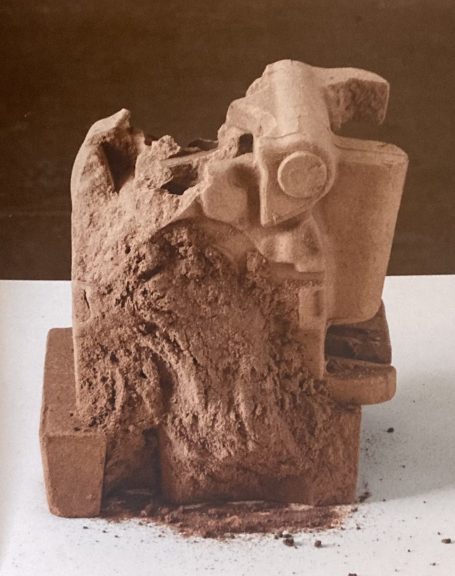
Colin Booth, Ozymandias, 2024
It would be very easy to enter a studio full of surreally mended furniture discards and fragments of colloquial speech written into light fittings or stone plaques, and to espouse such a sensibility as a resurfacing of the age-old romance of ruin lust. A belated echo of those celebrants of nature’s reclaiming of castles or cathedrals, those fetishists of the time-patinated, those revellers in the folly of man to attempt to withstand the entropy of decay. Where, in previous epochs, such indulgers of vanitas-manifest stood to challenge the rise of the machine, the industrialisation of the landscape, of labour, and of personal relationships. Today, such behaviours feel far more complicit with those same ubiquitous technologies which they purport to disavow. The photo-op of Brighton’s burned-out West Pier or the community kintsugi workshop for the leisured classes allow us each to buy into the thrill of the beautifully broken, the authentically aged – at least for an hour – before we eagerly post iPhone snaps to our elegantly curated social media channels. It’s all too complicated; we’re in too deep. There is no longer a clash of nature vs. culture, nor a binary of classicist and romantic. We are each now sympathisers and perpetuators of both sides. We are decentred, we are plural, we are conflicted, and we are hypocritical, and (as Rosanna McLaughlin salvages from Tom Wolfe) the hipster middle classes are the least prepared to accept the egalitarian possibility that grows out of an acknowledgment of this muddiness).
Colin Booth is a collector of fragments. Moreover, he is an enthusiast for the strange afterlife of fragments. The studio is an Aladdin’s Cave of broken, soiled or abandoned bits and pieces. Many are mid-way through their journey to becoming perplexing sculptural objects. While these mute hybrids of manufacture and horticulture, of mass production and the handcrafted, momentarily court the sentimental indulgences of their viewer, as a tender mend, or a triumph of poetry over utilitarian function, they do not allow such a reading to settle definitively. Colin does not seek out archetypal or celebrated objects in order to revel in their hubristic decline. He collects damaged Ikea stools, the oil-stained jacket of a retiring car mechanic and junk shop paintings. He collects ordinary things without knowing what they might yet become. His love of the quotidian however, doesn’t mean that he is afraid of the exemplary or the special. In an ongoing series of text works, the holey verses of Sapho re-enact the dance of their speculative meaning, tantalizingly withheld. Yet these timeless utterances are not treated any differently from the similarly anachronistic fragments of (Colin’s native) Geordie dialect. Colin does not treat the mighty as if it were lowly, humble, or commonplace. No, he treats the commonplace and the lofty both, as if they were each ordinary, interesting things. Neither is his process a simple subjugating of the autonomous producer to the idiosyncrasies of the artist’s intervention. Colin is as likely to employ the (one supposes, bemused) lacquer finisher or neon fabricator or cabinet maker to enact the required transformation of the dilapidated relic to bring about its fresh manifestation.
A favourite work for me is Ozymandias a crumbling sandcast mould once (perhaps) used in the production of an engine part. The thing is unapologetic in the way it holds a sense that it was made within a broader sequence of actions, with a specific purpose in mind. The techno-ergonomic contours have begun to erode, revealing a collapsing cliff face familiar to all those who walk along the soft rock edges of this East Sussex coastline. At the same time, the granulating form gives up its material self – while understanding the shape and size of a machine part, and seeing the image of a vast weather-beaten cliff, we see too the millions of sand grains which eventually will each shed the burden of coalescing into this index of a engine, this picture of a landform. This rescued and arrested sculpture conjures the epic and the elemental, it suggests a sense of time that merges production line rapidity with the slow passing of millennia. It hums and fizzes with nascent reverberations of Robert Smithson’s Nonsite and J G Ballard’s Crash and Jacob Epstein’s Rock Drill without the need to lock these into a static sense of what this object ‘means’ when considered atop a gallery plinth. At the factory these sandcast moulds will be used and destroyed daily. There isn’t anything special about this elaborate sandcastle – and yet, that is exactly why it becomes special when our thinking-looking is slowed down sufficiently to see beyond the superficial. It is because the building of sandcastles all of a sudden seems uncontrovertibly tied to the production of car parts. Not in order to wilfully confuse children’s play with adult work, or to whimsically muse upon the transience of all things, but because the making of sandcastles and engines have something fundamental in common. It is no great, profound revelation. It is simply a new observation (amid the other, simultaneous image-forms that the object still retains) that connects one bit of the world with another.
The work very deliberately takes its title from (Sussex-born) Percy Bysshe Shelly’s 1818 swipe at the pomposity of monarchic leaders, the poem’s protagonist recalling a second-hand tale of a once-grand desert statue fallen into disrepair. My above thoughts on crumbling sandy cliffs and eroding machines consolidate this titular borrowing. But if that were all that were going on, then this sculpture would be less than half as interesting as it actually is. Shelly’s writing of the poem was inspired by the contemporary purchase by the British Museum of a 7.25-ton head-and-torso of Ramesses II. Colin’s sand-engine strangely bares glimpsed echoes of that ancient Egyptian mortuary monument in its contoured plains and clearly defined forms giving to damaged edges. But the real frisson that Colin’s Ozymandias conjures is with the shifting sands of authority and responsibility that the ownership of such an artefact has in Britain today. The British Museum continues to be a respected seat of scholarship and an extraordinary repository of many global stories which inspire understanding and wonder. It is also a hangover from the days of colonial empire, exploitation, and pillaging. The British Museum (and by an extracted continuum, all forums for cultural display) is now both. There are some among us who call for repatriation, which in many cases is a worthy and inevitable outcome. But such a debate only shows to reveal that a line cannot be convincingly drawn between those objects that might ‘rightfully’ remain within this veritable British institution, and those which must be scanned for 3D printing or VR headsets before being shipped to museums closer to their place of creation.
Just as I have made (what might be considered) a kind of knight’s-move connection between the sandcast engine and the politics of the repatriation of museum objects, let me take things even further. 8 years before writing Ozymandias, Shelley co-authored the pamphlet Posthumous Fragments of Margaret Nicholson. Nicholson was still alive at the time of writing. And although she had made an attempt to assassinate Kings George III, the anti-monarchist verses are not hers, but Shelley’s and Hogg’s. In fact, the young (male) poets had little in common with the tortured Nicholson, her story, like the imminent arrival of the sculpture fragment at the BM, was merely a spark from which parallel and simultaneous stories might evolve.
The text you are presently reading began with a broadside against the indulgent romantic whimsey of ruin lust, before (counterintuitively) following a tenuous line through one great Romantic poet’s oeuvre, in a collective attempt to describe a contemporary sculptor’s studio practice and one fascinating sculpture. This text might itself be analogous to the way that Colin’s works connect disparate parts, almost convincingly, as if such a chimeric whole were inevitable, whilst never allowing the thing to settle into something ‘right’, or ‘knowable’, or ‘finished’.
Colin is a sculptor of posthumous fragments. While the use life of his objects is over, their complex web of future possible lives is only just beginning.