< back to writing menu
white pages are unpublished or just thoughts previously shared on instagram (etc) / yellow pages are published texts
24 - 28/08/2021
The Dusty White Bloom of the South Downs
for @painttech_falmouth
at the invitation of Nina Royle
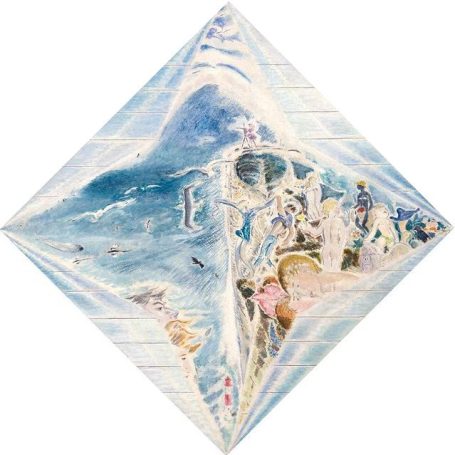
Jeffery Camp, Knapweed and Mallow at Beachy Head, 1993
Beachy Head stands as the prelude to the Seven Sisters and begins a succession of rolling elevations that stretch from the southern tip of Eastbourne to the Cuckmere Haven.
The soft spine of the South Downs, pocked with shallow chalk quarries and dipping down at Rodmell to accommodate the meandering Cuckmere River, is recorded again and again in the paintings of Vanessa Bell. The estuary at Cuckmere Haven, where the quiet river cuts exaggerated curves into the plateau, as if hesitant at joining the salty waters of the Channel, is known to us by the tender pictures of Eric Ravillious. Beachy Head, despite its fame and extra-ordinary picturesque possibilities, belongs to Jeffery Camp alone.
The exhibition Some People Dream a Lot at Kestle Barton ends on Saturday 4th September. It includes 4 large paintings of Beachy Head as well as numerous small and oddly shaped panels, all made between the early-1970s and the mid-2010s.
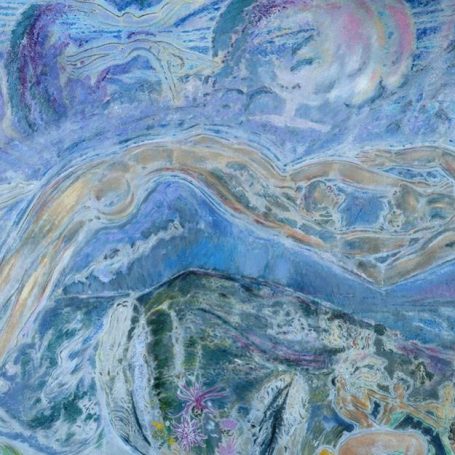
Jeffery Camp, South Downlands (detail), 1990
Jeffery Camp and Beachy Head
These pictures are often written about because of their pictorial conjuring of vertiginous drops down, over the cliff’s edge, or their blissed-out and eternally youthful sunbathers, or their extreme depictions of gusting winds or summer downpours. Less remarked upon through this extensive body of work, is how all the colours are tempered (or tinted) by a dry white which unifies the palette into something fundamentally ‘of the South Downs’. Contrast these pictures with the darker, murkier Thames paintings or the earthier hues used to capture the muddy beach at Pakefield to see what I mean.
Earth-flecked chalk has the colour of old bones and the South Downs grasslands can feel like the soft curving dermis of a nimble body (‘Like twisting hips in a petrified dance’, Camp), only betraying its weather-beaten antiquity at its extremities, where the cliffs crumble into the relentless waves. Chalk is the skeleton of the South Downs, chalk determines its contours and tempers its hues.
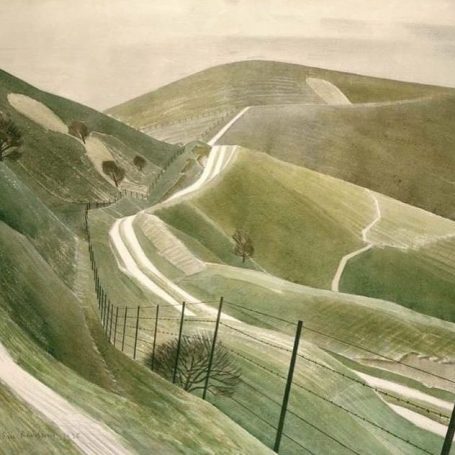
Eric Ravillious,,Chalk Paths (detail), 1935
Eric Ravillious and the Downs in winter…
Eric Ravillious grew up in Eastbourne but left to study at the Royal College of Art. He returned to spend more and more time in the South Downs in his 30s, painting the fields and coastline around Beddingham, near Lewes.
With a determined pursuit of form within his compositions, Ravillious preferred the clarity afforded in the winter months. The gentle curves of the Downs cut through with white-line paths made by walking, and the snaking Cuckmere River reflecting the cold bright sky allowed his pictures to achieve a finely balanced arrangement of shape and line.
The cool winter light, the leafless trees and the exposed and thinly grazed escarpments equally rewarded his painting method of applying watercolour with a dry brush, scraping the pigment onto the paper in rhythmical and repetitious scratches. In other methods of watercolour painting the white of the paper illuminates the coloured washes from within causing the colours to appear bright and glassy. In Ravillious’ technique, the white of the paper shows through between the colour areas and manifests as a colour in its own right. The white of the paper comes to the surface of the painting just as the chalk comes to the surface of the South Downs between the tufts of grass and in the inscribed criss-crossing network of paths.
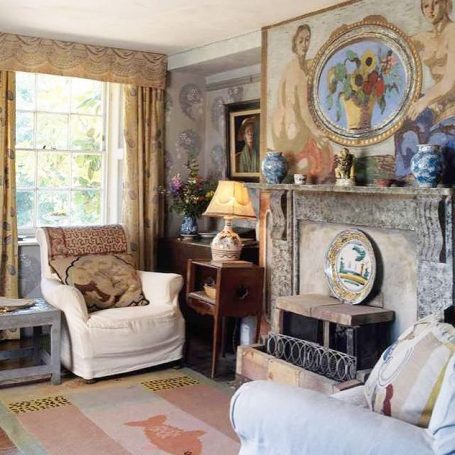
Charleston Farmhouse, Sussex
Vanessa Bell and Charleston
The South Downs (like their northerly counterpart beginning 60 miles away at Dover and running west) is a chalk landscape. This soft stone (formed by marine deposits in the Cretaceous period) weathers into a soft, curving topography that carries a very thin layer of topsoil with grasses and flowering plants. The Downs are pocked by shallow quarries (historically used in the production of lime for cement and as a soil improver) exposing the bright stone amid the soft green rolling hills. The thinness of the soil reveals the chalk substrate everywhere in gashes and chunks and powdery pebbles. The constant erosion of the chalk into a fine dust means that the soil colour is modified by these infinite white specs, becoming (what we might call) a pastel shade. Seen from a distance, the eye tends to blend the short dusty grasses with the pale pink-brown soil, creating a sense that the hillside has a glaucous bloom, like on the skin of a plum or a damson.
Vanessa Bell painted the landscape around her home at Charleston in the South Downs capturing the arable low-lying fields and higher, grazing pastures of the beacon. Bell’s colours capture that chalky bloom which tempers the hot and dry tegument.
Charleston is of course both painting subject and painting substrate, it’s every wall, table, bedhead and door painted by the artists who lived in it. Buying pigments over the counter from Boots the Chemist in nearby Lewes to create distempers, these decorating colours too are mixed to create a palette which reflects the chalky tints of the surrounding landscape.