< back to writing menu
white pages are unpublished or just thoughts previously shared on instagram (etc) / yellow pages are published texts
2018
Vile Bodies
in
The Kiss or Poison Boyfriend of Jesus' Blood published by Kingsgate Project Space
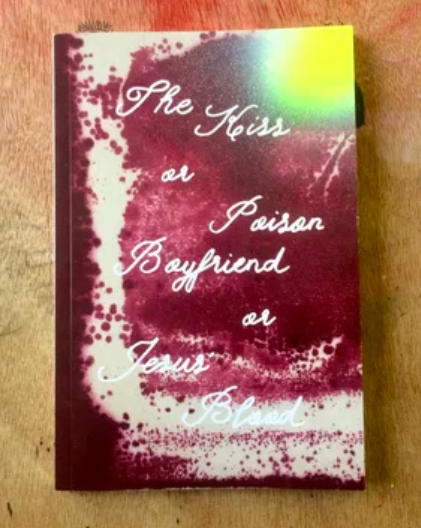
cover of The Kiss or Poison Boyfriend or Jesus' Blood featuring a detail of Rebecca Guez' Small Sucker (with hand painted addition to top right):
Vile Bodies
At the height of the boom [just before the collapse of the New York stock exchange in October 1929], people were buying editions they hadn’t even seen, and putting them into folios and strong rooms as investments. Everyone was doing it… It was a case of entirely fabricated values. I was sorry to see it going that way.
Paul Drury in Graham Sutherland: A Biography, Roger Berthoud, 1982
In 1924 Willy Larkins brought into the etching studio at Goldsmiths College a copy of Samuel Palmer’s The Herdsman’s Cottage (1850) which he had found in the Charing Cross Road. Palmer’s technique of an all-over tissue of marks, over-bitten and laboriously polished, was seriously out of fashion by the ‘20s, but the power of this rediscovered work became a challenge and an example to his friends Graham Sutherland, Paul Drury and others. Palmer’s conjuring of an ancient landscape, one of lunar cycles and a closeness to the rhythms of the earth, must too have offered an anti-rational possibility of hope to those seeking meaning among the ruins of WWI’s progressive ideology.
And so it was, that the works made in the light of this epiphany, themselves regretfully became the vulgar commodities bought and sold unseen; their arcane scenes of contemporary Kent accreting the superfluous abstraction of monetary value that Drury bemoans.
Until of course, it all ended.
***
Any crisis within the currency systems of global powers will obviously effect the ability and preparedness of collectors and consumers to purchase new art works. Whilst, at the same time the stock of art objects already held within those collectors’ strong rooms quickly become bathetic paper cheques that nobody will cash. In the late-1920’s artists working in print media were no less vulnerable to the tumult of the market than the Neo-expressionists of the 1980’s or the Zombie-formalists of the twenty-teens. The ’29 crash brought to an abrupt halt the so-called English Etching Revival whilst the out-of-sight folios of beautiful and densely intagliated landscape vistas slowly transformed (in the mind of their owners) into mere ink-stained flotsam.
From this distance, however, we can see the metamorphosis of English etchings in 1929 as something far more interesting and complex. Those transforming leaves are a metaphor and a testament to print’s live possibility. Just as the unearthing of Palmer’s Herdsman’s Cottage inspired a new engagement with image making and with the English landscape beyond its urban centres, so too are we aware that the great print works of Sutherland (et al) can still be found in museums and private homes today, and that we can continue to feed from and engage with them, untainted, by their former status as promissory notes to some failed mercantile system. They are new again.
***
Printmaking has long been lionized as a quintessential democratic art form. Devoid of a unique and uniquely prized object, prints can be produced in multiples and disseminated broadly and at relatively low costs. This wholesome and rose-tinted celebration of print’s virtue is naïve and ignorant. Not only does it presume a sufficiently (but not too) affluent audience to domestically purchase and treasure these inked, stained or inscribed papers. This attitude also, and fundamentally, fails to grasp print’s insidious, corrupting and anarchic potential.
Let us think about those printed leaves in the dark of those storerooms during the months and hours leading up to their abandonment as the market bubble burst. Art objects have no integral value (except of course a bronze, or some daft construction in precious stones), but they do have a spiritual potency. They are odd. They can make us look at the world differently. They are transformative and they survive. Can we then see these potent agents as something like a virus or a mold spore? Something insidious. Something that feeds on its host, uncaringly. Something that outlives.
This insidiousness was clearly never the artists’ intent. But then, when did the artists’ intent ever actually manage to tame truly great artworks?
In 1970 Cildo Meireles began his Insertions into Ideological Circuits: Coca-Cola Project where he purchased bottles of the US super-brand beverage, overprinted their glass containers with instructions for making Molotov cocktails, or with slogans such as ‘Yankees go home!’, and secreted these affected/infected bottles back into the distribution networks of his native Brazil.
In 2011 Mathew Sawyer bought a GAP logo hoodie, into the inside of which he stitched a 40,000 year old mammoth hair, and then returned the garment to the London store for re-sale.
These two actions are strategically considered. One is politically charged and agitating. The other is weird, and probably a little bit itchy for someone somewhere. But each of these strategies only serves to prescribe a trajectory that art objects (perhaps especially print works) already operate within. Each print is like a virus, and it is also like a seed. It may take root like a hard to tame weed; it may have the fire and occultist power of a mustard seed; it may be the gluey unscrubbable stain of spent ejaculant. In any case, we should not be fooled by its neat and modest form.
Print is a quiet and powerful thing. Print is complicit and feeds nicely the supply chains of desire and ownership. These objects can be, and are, loved and cherished. But they are also unruly. They will not love you back. They won’t return you a cast-iron profit. They will ingress the fabric of your home and of your family; of our society and systems. They will go down with the sinking ship, but will then re-appear in a box at the back of a dusty shop on the Charing Cross road, and then they will insist that we look at them again; that we think about how we see the world, again.